The 3-Year Time Capsule: Why Ends Age Differently
Clients always ask us the exact same question in our shop: 'Why is my wig silky and gorgeous down to the shoulders, but the bottom two inches feel like stiff sandpaper?'
Look at the calendar. It's simple math. It really is.
Human hair grows about half an inch per month. If you're wearing an 18-inch or 20-inch raw temple hair wig, the tips of those strands grew out of someone's scalp more than three full years ago. That's a very long time.
Think about what those tips went through during those three years:
- Over 1,500 daily brushing sessions. You can't undo that friction.
- Hundreds of shampoo washes with hot water. They've been stripped over and over.
- Countless blow-dryers, hot curling wands, and flat irons. We've seen it all.
- Endless rubbing against wool sweaters, denim jackets, and cotton pillows. It's constant wear.
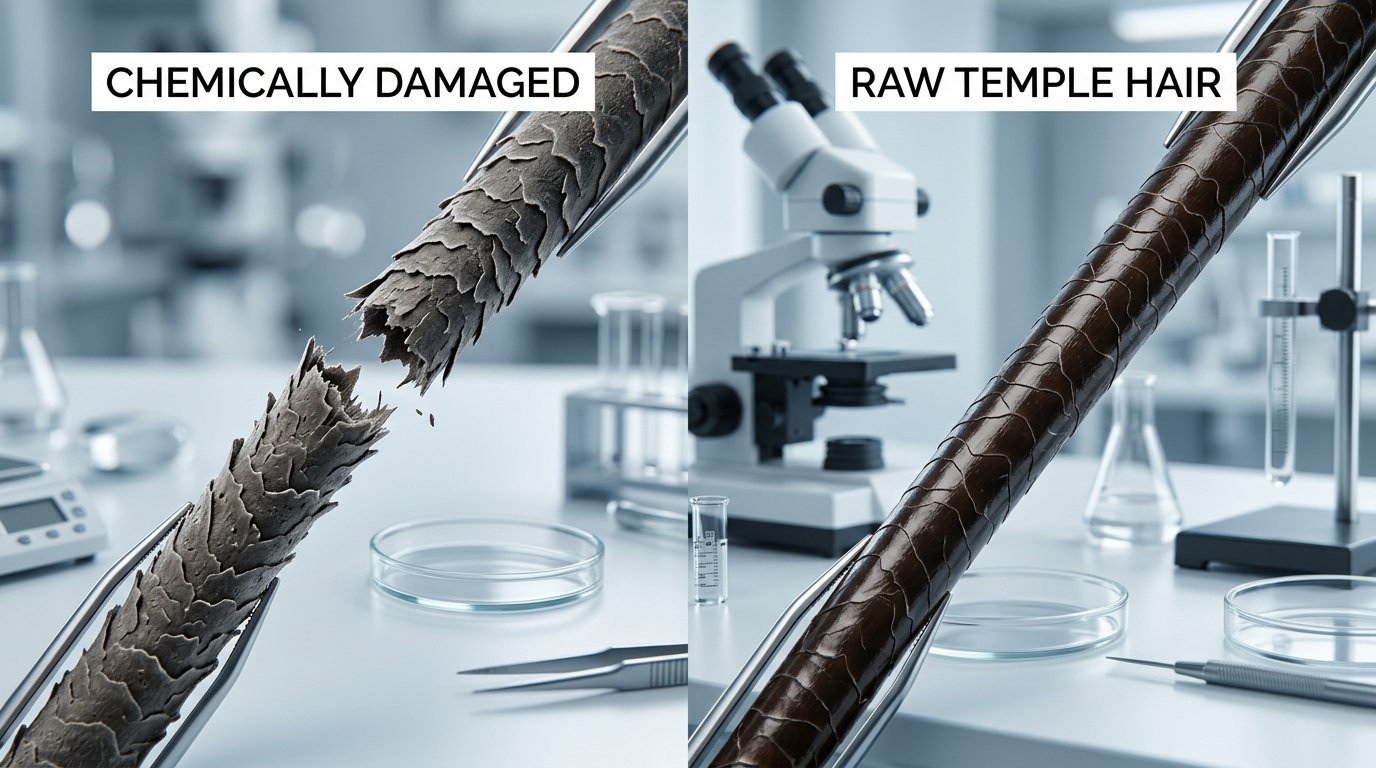
By the time hair reaches your chest, its outer protective shield—a natural lipid coating called 18-MEA—is completely gone. It's wiped clean out. Without that natural wax layer, the cuticle shingles begin to lift, curl, and chip away. Under a microscope, fresh roots look like smooth shingles on a slate roof. The ends look like an old, splintered wooden fence post in a hurricane. It's no wonder they feel rough. That's just what happens when hair isn't protected.
The Brush Jam: Why All Tangle Force Compresses at the Tips
When you brush your hair from the top down, where do all the knots go?
They slide down the strand. You push loose snags, shed hairs, and lint down ahead of your brush bristles. By the time the brush reaches the bottom three inches, all that tangled resistance has compressed into one tight, dense knot right at the very tip. That's where trouble starts.
If you yank your brush through that final jam, you'll concentrate hundreds of grams of pulling force onto the thinnest, oldest part of the strand. That sudden yank rips cuticle scales clean off the hair shaft and tears the cortex apart. Don't do that. The ends will fray, snap, and develop that dreaded crinkled look that won't lay flat.
Always hold your hair like a ponytail in your fist and brush the bottom two inches first. Once the tips are completely tangle-free, move up to the mid-lengths. You'll cut breakage by 90% overnight. It's really that simple.
The Slow-Glide Trap: Scorching the Thinnest Part of the Strand
Watch how people flat iron their hair. They clamp down near the roots and pull down at a brisk, steady pace. But what happens when they get to the last two inches?
They slow down. They hesitate to bevel the ends under. They clamp down hard and pause for two seconds.
That hesitation is pure poison for your hair.
Remember: the ends are already 30% thinner than the roots because they've lost multiple cuticle layers over the years. Trapping high heat on that diminished, lipid-starved tip instantly boils out any remaining moisture. The keratin proteins bake into a brittle, glassy crust. If you want turned-under ends, use a round brush with warm airflow, not a 380°F flat iron clamped down in place.
Shampoo Stripping: Why Ends Starve for Natural Oils
On your natural head, your scalp produces sebum—natural biological oil that lubricates the hair shaft. But sebum travels slowly. It rarely reaches past the first six inches of hair, leaving the ends completely dry.
And on a wig or weave, the situation is even more extreme: there is zero scalp oil whatsoever.
Every time you lather up your hair with a high-sulfate shampoo, you strip away whatever delicate conditioning oils were sitting on the ends. If you pile all your hair on top of your head and scrub the ends into a lather, you're grinding raw, unprotected cuticle scales together like sandpaper. Never lather the ends. Cleanse the roots and lace cap, and let the soapy water gently rinse down the lengths on its own.
The Hydrophilic Shift
Healthy roots are hydrophobic—they repel water and hold onto oils. Weathered ends are hydrophilic—they soak up water like a sponge, swell up, and then bleed that water right back into the dry air within minutes. That's why ends dry out so fast.
Daily Weathering: Sun Oxidation & Humidity Frizz
Even if you never pick up a flat iron, your hair ends take a daily beating from Mother Nature.
Sunlight oxidizes natural sulfur bonds into cysteic acid, bleaching your hair's natural dark melanin into brassy orange-brown tones. Combine that with high humidity, and the lifted cuticle scales at the tips swell irregularly. The strands start curling away from each other, creating that fuzzy, frizzy halo at the bottom of your style that ruins a sleek blowout.
Wool Coats & Cotton Pillows: The Hidden Nape Graters
Do your hair ends tangle and mat specifically at the back of your neck?
Look at what you're wearing.
Wool coats, heavy cotton hoodies, rough scarves, and car seat headrests act like literal cheese graters against fine hair. Every time you turn your head, the ends grind against coarse fabric fibers. The friction strips away remaining cuticle tiles and tangles the strands into knots.
If you wear expensive hair systems or long extensions during winter, tuck your hair up off your wool collar, or line the inside of your coat collar with a smooth silk or satin scarf. And never sleep on a rough cotton pillowcase—use 22-momme pure mulberry silk only.
| Hair Section | Chronological Age | 18-MEA Lipid State | Cuticle Layers Intact | Required Maintenance |
|---|---|---|---|---|
| Roots (First 3 Inches) | 1 to 6 months | 100% intact; naturally hydrophobic | 8 to 10 overlapping layers | Gentle cleansing, light hydration, avoid roots with heavy grease |
| Mid-Lengths (4 to 12 Inches) | 1 to 2 years | Partially worn; 60% intact | 5 to 7 layers intact | Balanced conditioners, argan oil drops, comb-chase heat styling |
| Distal Ends (Bottom 3 Inches) | 2.5 to 3.5+ years | Completely stripped (0% native lipids) | 1 to 3 layers or bare cortex | Pre-shampoo oiling, heavy lipid sealants, frequent micro-dusting trims |
The Silicone Crust Trap: False Moisture vs Real Hydration
When hair ends start feeling dry and rough, what is the first thing most people do? They pump three drops of cheap hair serum onto their hands and slather it over the tips.
It feels soft for four hours. By tomorrow morning, the ends feel stiffer and drier than before.
Why?
Because cheap hair serums are packed with heavy, non-water-soluble silicones and drying alcohols. Those silicones form a waterproof plastic film over the hair shaft. While that film gives temporary fake slip, it completely blocks real atmospheric moisture and leave-in hydration from entering the core. Layer that on day after day, and you build up a hard, crunchy polymer crust that makes ends snap like dry twigs.
Before you moisturize dry ends, clarify them. Strip away that plastic buildup with a gentle clarifying wash, hydrate with a water-based leave-in, and seal with a pure botanical lipid like argan or jojoba oil.
The Reverse Conditioning Trick: Protecting Ends Before Washing
Here is one of our absolute best workshop secrets for reviving dry ends: the reverse emulsion wash.
Before you ever step into the shower or wet your hair piece, smooth a small amount of lightweight oil (like argan or sweet almond oil) or a rich conditioner onto the dry bottom three inches only. Let it sit for five minutes.
Why do this?
The oil fills in microscopic cuticle gaps and coats the weathered tips in a protective lipid shield. When you subsequently apply shampoo to the roots, that shampoo cannot strip moisture out of the ends as the suds rinse down. The ends stay nourished, soft, and protected throughout the entire wash cycle. Try it once, and you'll never wash hair the old way again.
Micro-Dusting: Why Trimming a Quarter-Inch Saves the Whole Piece
People hate the word 'trim'—especially when they've spent good money on a 22-inch wig. They want to preserve every millimeter of length.
We understand the hesitation. But avoiding trims is the fastest way to ruin a wig.
When a hair strand splits at the tip, that split doesn't stay at the tip. Like a run in a pair of silk pantyhose, that split travels upward down the shaft. A tiny split at the bottom can travel two, three, or four inches up the strand within a few months, turning the entire lower half of your hair into a frizzy, tangled mess.
Enter micro-dusting. You don't cut off two inches. You take sharp professional hair shears and snip off just a tiny sixteenth or eighth of an inch—literally just the dead, split tips. You don't lose any visible length, but you eliminate the frayed edges before they can unravel the hair shaft. Micro-dust your wigs every four to six months, and the hair will look thick and healthy from root to tip for years.
Recognizing Split Ends: From White Dots to Feather Splits
Inspect your hair ends under bright daylight once a month. Here are the four stages of end damage:
- Stage 1: The White Dot: A tiny white speck appears near the tip. That's a point of severe mechanical stress where internal keratin has fractured. The strand will snap right at that dot within days.
- Stage 2: The Classical Fork (Trichoptilosis): The hair shaft splits into two clean branches at the tip. Trim it immediately before the split migrates upward.
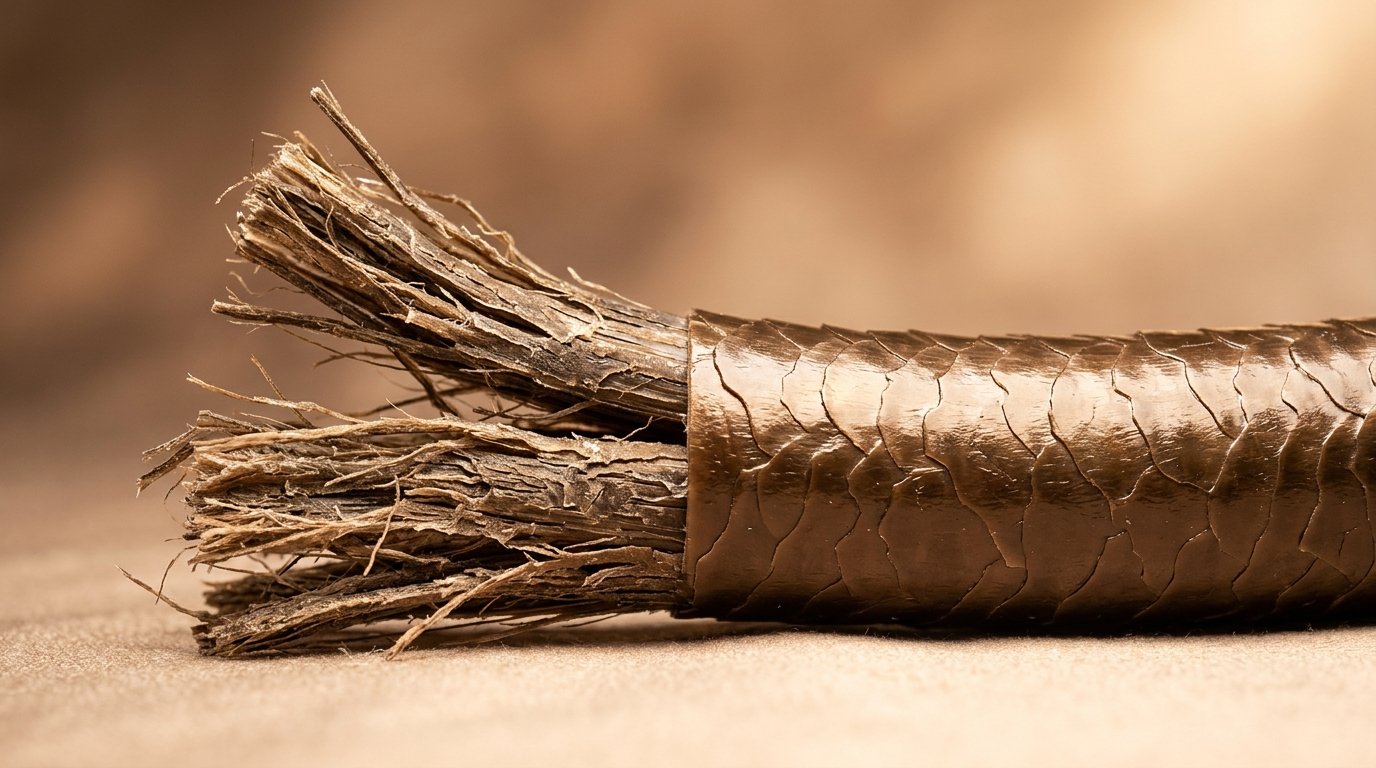
- Stage 3: The Feather Split: The cuticle is completely gone, and the inner cortex has frayed into multiple fine fibers like an unraveled rope. The hair tangles constantly and catches on clothing.
- Stage 4: Fairy Knots (Trichonodosis): Common on curly textures, single strands loop and tie themselves into microscopic knots near the ends. Combing over a fairy knot snaps the strand instantly.
Don't let damage travel up your hair. Catch it early, moisturize smartly, and protect those tips like the precious three-year-old silk they are.