Elasticity vs Strength: Two Completely Different Animals
Hair brands love tossing around the words strength and elasticity like they mean the exact same thing. They don't.
In fact, confusing the two is one of the easiest ways to ruin a luxury hair piece.
Let's break down what each term actually means in plain English:
Tensile Strength: This is brute force. It's the maximum pulling weight a single hair strand can take before it physically snaps into two pieces. A healthy, unprocessed human hair strand can hold around 100 grams of suspended weight. If you gathered an entire healthy head of raw hair, it could theoretically hold up several tons of weight without ripping. That's real mechanical strength.
Elasticity: This is flex and recovery. It's how far a strand stretches under tension, and whether it springs back to its original length once you let go. A healthy wet strand of raw hair can stretch up to 30% or even 50% longer than its resting state, and bounce right back without warping.
Now here's the catch:
Hair can have incredible elasticity and almost zero strength.
We see this constantly with heavily bleached blonde extensions. When wet, the hair stretches like cheap bubble gum. It stretches and stretches—until the slightest snag on a brush snaps it clean off. The elasticity is sky-high, but the structural strength is completely dead.
On the flip side, hair overloaded with heavy protein treatments gets rock-hard. It has huge static strength, but zero elasticity. Bend it sideways, and it shatters like dry pasta.
The Physics in Simple Terms: Stress vs Strain
In materials testing, Stress is how hard you pull on the strand. Strain is how much longer the strand gets while you pull. The sweet spot is a high resistance to pulling combined with a clean, instant bounce-back. That's the hallmark of untreated virgin hair.
The Molecular Coil: What Really Happens When Hair Stretches
To understand why hair stretches like a spring, look inside the cortex. The cortex makes up about 90% of the entire hair shaft. Inside it sit millions of coiled keratin proteins bundled together like tiny cables.
When hair is resting, those keratin proteins sit in tight spiral coils called alpha-keratin helices. Think of a telephone cord or a tiny metal spring. Hundreds of hydrogen bonds and sulfur-rich disulfide crosslinks lock that spring into its coiled shape.
Here's what happens step-by-step when you pull on a strand:
- The Gentle Stretch: Under light pulling tension (the first 2% to 3% of stretch when dry), the spring gently extends. Weak hydrogen bonds stretch without any permanent harm.
- The Alpha-to-Beta Shift: Keep pulling, especially when the hair is wet, and those tiny coils physically unroll. They flatten out into long pleated ribbons called beta-keratin. This molecular uncoiling is the exact reason healthy wet hair can stretch so far without breaking.
- The Disulfide Brake: Once the coils are stretched to the limit, the surrounding protein matrix kicks in. Strong disulfide bonds act like safety cables, stopping the fibers from sliding past each other and tearing apart.
Let go of the hair, and those ribbons snap right back into springs. That's assuming your disulfide bonds are still alive.
The Snapback Curve: Hookean Zone vs Permanent Damage
Every time you comb, brush, or braid your hair, you put it through mechanical tension. How that hair recovers depends on how far you push it along the stretch curve:
Zone 1: The Safe Spring Zone
Under light pulling (up to 2% stretch when dry, or 5% when wet), hair behaves like a perfect spring. Let go, and it snaps back to 100% of its original length with zero damage. Daily finger-combing and loose styling live safely in this zone.
Zone 2: The Danger Zone (The Yield Point)
Pull harder, and you cross the yield point. Here, hydrogen bonds break open in droves. The hair feels noticeably looser in your hands. If you let go now, the strand won't return to its original length. It stays stretched out, thin, and warped. Stylists call this plastic deformation. Once a strand deforms like this, its internal armor is permanently weakened.
Zone 3: The Snap Zone
Keep pulling past the yield point, and you hit the breaking load. The internal protein matrix gives up, the remaining disulfide bonds rip in half, and the strand snaps with a sharp audible pop. If this happens mid-shaft, you get split ends and frizzy halos that no serum can repair.
Chemical Havoc: How Bleach Destroys Cystine Bonds
Nothing destroys hair strength faster than chemical bleach and low-grade factory processing.
Healthy hair gets its toughness from a specific amino acid called cystine. Cystine molecules form double-sulfur bridges (disulfide bonds) that link keratin proteins together like steel rivets in a bridge.
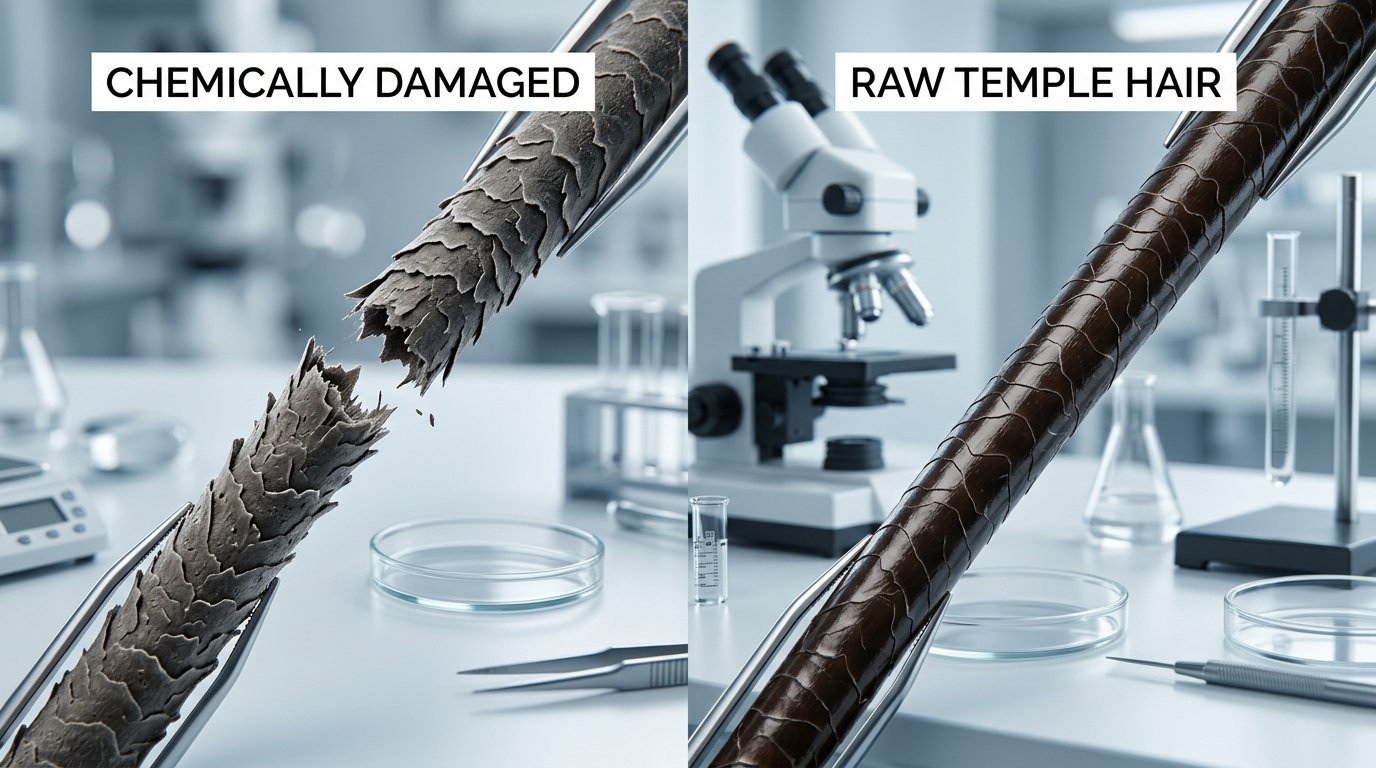
When hair is dunked into bleach or harsh ammonia, those chemical oxidizers don't just destroy dark melanin pigment. They also rip through cystine bonds, converting tough sulfur bridges into weak cysteic acid. Every time you bleach hair from dark brown to platinum blonde, you permanently wipe out between 30% and 50% of its natural disulfide rivets.
What are you left with? A strand that feels mushy, stretches like chewing gum when wet, and has lost more than half its break-force strength. It might look gorgeous on camera under bright salon lights, but the structural core is hollowed out.
Heat Damage: Why Flat Irons Make Strands Glass-Brittle
Heat damage doesn't stretch hair out. It does the exact opposite: it turns hair into brittle glass.
When you clamp a flat iron running at 420°F (215°C) onto hair, two destructive things happen almost instantly:
- Keratin Melting: Alpha-keratin proteins physically denature above 390°F. The coiled springs melt into a disorganized, glassy mass that loses all elasticity.
- Moisture Explosions: Water trapped inside the cortex boils instantly into steam. That steam expands rapidly and blows microscopic craters through the cuticle walls.
After months of daily flat ironing, your hair might feel straight, but it has lost its ability to bend. The next time you run a brush through it, the strands don't stretch at all—they shatter into tiny two-inch fragments that litter your bathroom sink.
Everyday Friction: Why Rough Combing Snaps Healthy Hair
You don't need bleach or curling wands to break hair. You can do it with a plastic comb if you're careless.
Every time a comb catches on a knot and you yank downward, you create a sharp spike in local tension. That sudden yank concentrates hundreds of grams of pulling force onto three or four strands caught in the teeth.
Even worse is torsional strain—twisting hair while pulling it. Keratin fibers can handle pulling straight down along their length fairly well. But twist a strand sideways while pulling, and its tear resistance drops by more than 60%. That's why rough towel-rubbing and aggressive round-brush blowouts cause catastrophic shedding in hair systems.
| Hair Condition | Average Break Force | Wet Stretch Recovery | Comb Resistance | Primary Failure Mode |
|---|---|---|---|---|
| Raw Temple Hair (Silky Fusion) | 100–125 grams force | Stretches 30% and snaps back 100% | Exceptional; smooth cuticle glide | Minimal; handles daily styling for years |
| Single Bleached (#27 Honey Blonde) | 70–85 grams force | Stretches 20% with slight sluggishness | Moderate; needs leave-in slip | Splits at dry ends if unconditioned |
| Platinum Bleached (#613 Blonde) | 40–55 grams force | Stretches like gum, warps permanently | Poor; high friction drag | Mid-shaft snap under fast brushing |
| Acid-Bathed Factory Hair | 25–40 grams force | Brittle or gummy depending on moisture | Awful once silicones wash off | Disintegrates into short pieces after 5 washes |
Telltale Signs: From Bubble-Gum Stretch to Clean Snaps
How do you know if your hair's elasticity or strength is shot? Look for these real-world warning signs:
- The Bubble-Gum Stretch: When washing your hair, take two strands between your fingers and pull gently. If they stretch and stretch without fighting back, and feel mushy and limp like wet noodles, your disulfide bonds are blown. You have severe protein depletion.
- The Clean White Snap: If dry hair snaps with a loud click under light combing, leaving tiny white dots at the broken ends, your strands are heat-scorched and dehydrated. You have zero elasticity.
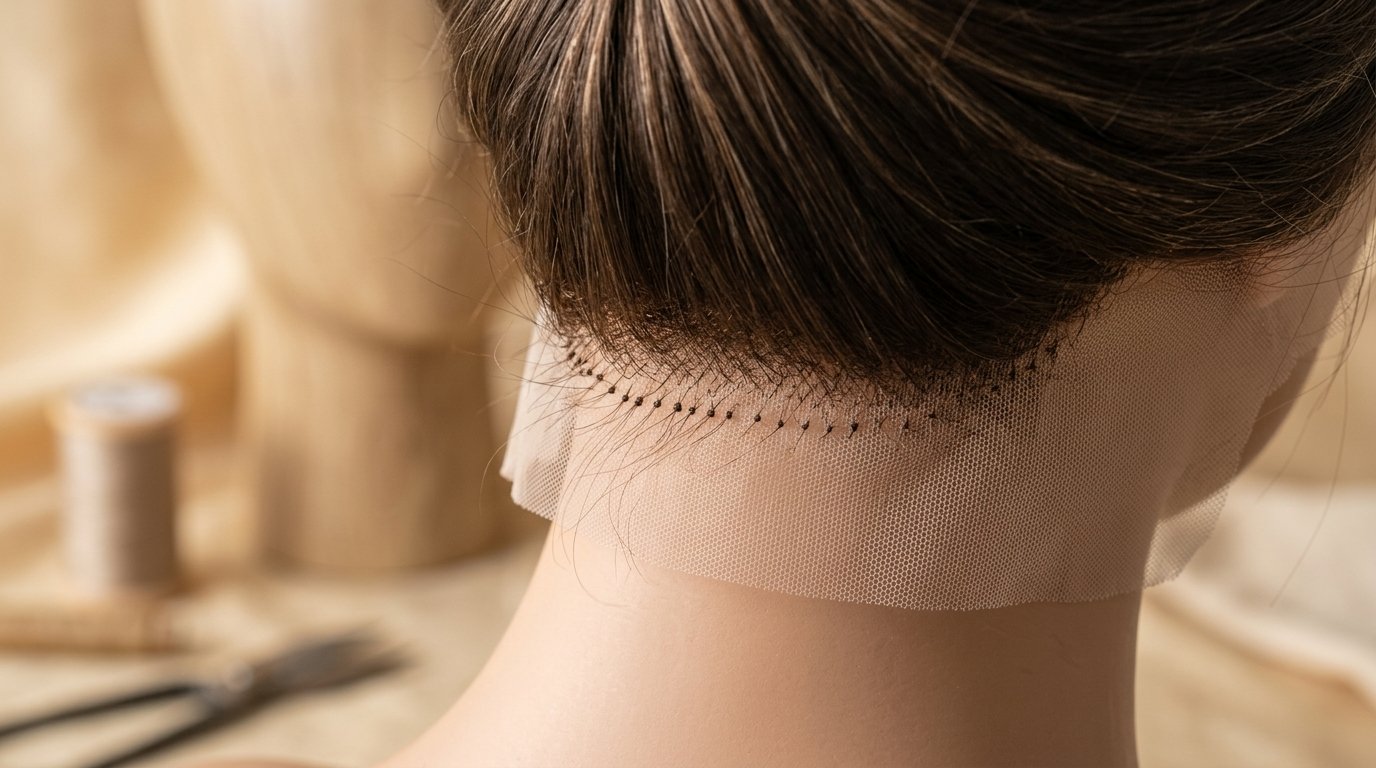
- Frizzy Nape Halos: Look at the nape of your neck. If you see hundreds of short, curly, wiry hairs poking out, that's not new growth—that's mechanical breakage caused by collar friction and poor detangling habits.
- Shedding Without Bulbs: When hairs shed from your wig or system, look at the ends. If there is no tiny root knot attached, that hair didn't shed from the lace—it snapped in half mid-shaft.
How to Protect Your Hair: Slip, Detangling & Moisture Balance
You can't replace broken cystine bonds once they're gone, but you can prevent healthy bonds from breaking in the first place. Here is our daily workshop protocol:
- Always Detangle from Ends to Roots: Never start combing at the top and yank downward into a knot. Start at the bottom three inches, work that section smooth, then move up. You cut mechanical strain by 80%.
- Never Brush Hair Bone-Dry or Soaking Wet: Dry hair lacks flex, while soaking wet hair has swollen cuticles and lowered break-force strength. The safest time to detangle is when hair is 80% dry with a slippery leave-in conditioner applied.
- Use Wide-Tooth Seamless Combs: Cheap plastic combs have rough mold seams down the middle of every tooth. Those tiny plastic ridges act like microscopic saws against your cuticle scales. Use seamless carbon or wooden combs only.
- Balance Moisture and Protein: If hair feels limp and gummy, use a light hydrolyzed silk treatment. If it feels stiff and straw-like, skip protein entirely and pack in fatty lipid conditioners.
The 10-Second At-Home Stretch Test: Wet vs Dry
Want to check your hair's health right now? Do this simple test in front of your bathroom mirror:
Isolate a single strand of hair that has fallen naturally. Hold the root end firmly with your left thumb and index finger, and grip the middle of the strand with your right hand about two inches apart.
The Dry Pull Test
Gently pull your right hand outward by about a quarter of an inch. A healthy strand will resist firmly, stretch just a fraction, and snap back tightly like a guitar string the second you ease up. If it snaps immediately with zero give, it's severely dried out.
The Wet Pull Test
Dampen that same strand with warm water. Now gently pull again. A healthy strand will stretch smoothly by about 25% to 30%, feel springy, and return to its original length when released. If it keeps stretching endlessly like warm taffy and curls into a crinkled coil when you let go, the cortex is severely damaged.
The Silky Fusion Standard: Raw Hair with Intact Keratin Coils
At Silky Fusion, we refuse to source acid-bathed floor hair or chemically melted bundles. Every piece we make starts with authentic, single-donor raw temple hair harvested in its natural ponytail alignment.
Because the hair has never been boiled in acid vats or stripped of its natural cystine bridges, its alpha-keratin helices remain fully intact. When you pull on our hair, you feel real natural resistance. When you wash it, it bounces back like healthy bio hair. It doesn't need artificial silicone coatings to fake quality, and it won't disintegrate after five washes.
Invest in hair that has real mechanical strength built into its biology. It saves you money, saves your sanity, and lasts for years.