What Heat Actually Does to Hair: Melting Keratin
We've all smelled it. You press a flat iron down, and a sharp, sulfurous stink fills the bathroom. That smell isn't product burning off. That's your hair's internal proteins physically breaking down. It's that simple.
Hair is mostly keratin—tough, coiled protein held together by hydrogen bonds and strong sulfur-rich disulfide crosslinks. When you style hair with heat, you're playing with those bonds:
- Hydrogen Bonds: These are weak bonds that let you reshape hair temporarily. Heat breaks them easily, letting you turn curls straight or straight hair wavy. When hair cools down, those bonds reform in their new shape. That's harmless temporary styling.
- Disulfide Bonds: These are the permanent biological welds holding your strand's structure together. Normal heat doesn't break them. But crank your iron too hot or leave it clamped down on a strand for too long, and you'll permanently destroy these sulfur bonds. Once they're scorched, sulfur dioxide gas vents into the air—hence the burnt hair smell. Those bonds won't ever come back.
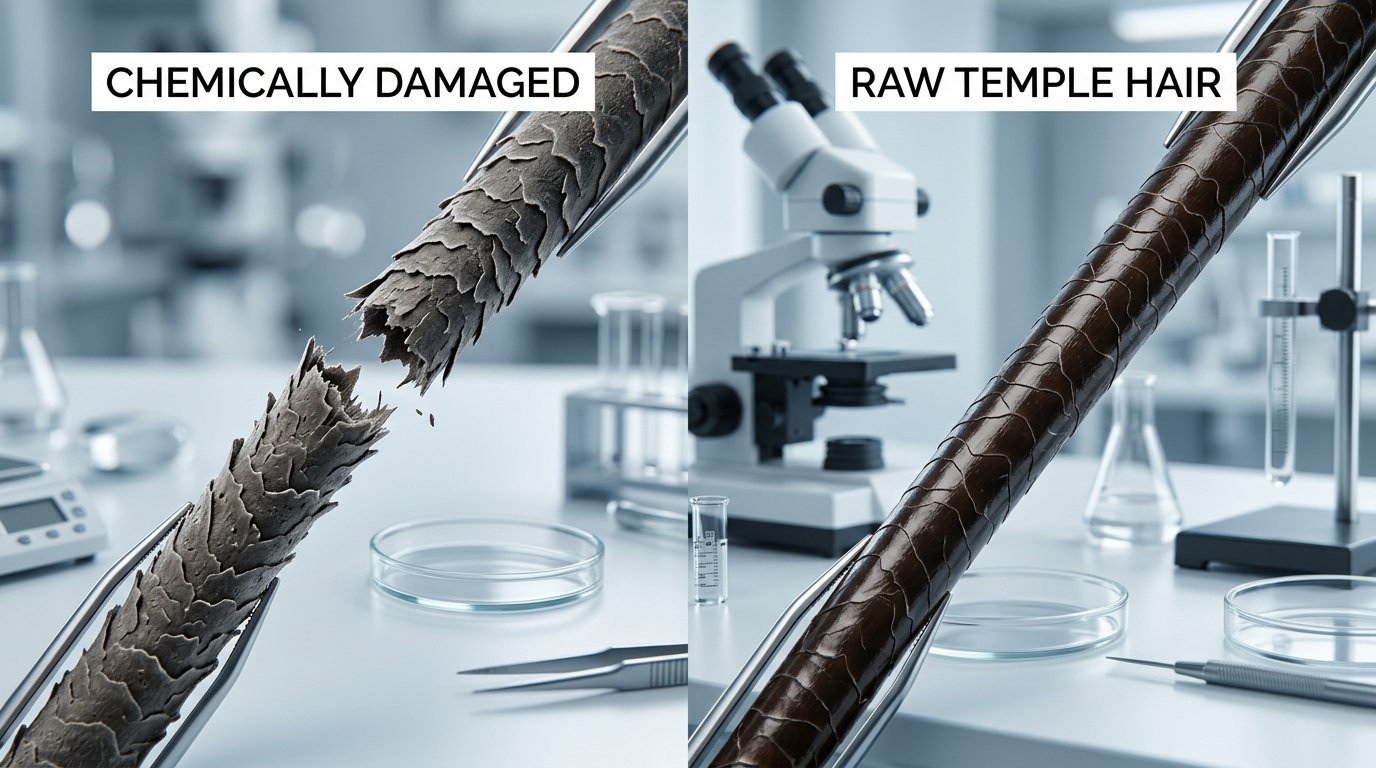
When you burn off those internal welds, your cuticle scales blister, lift, and chip off like burnt paint on a car hood. You don't want that.
The Reality of Heat Transfer
Hair has very low thermal conductivity. It doesn't soak up heat like metal. Heat transfers slowly from the outside plates into the center core of the strand. That means how long the iron sits on the hair—what engineers call dwell time—is far more dangerous than the temperature setting on the dial.
Temperature Danger Zones: From Safe Silk to Blistered Cuticles
Stop guessing what temperature dial to pick. Here is what actually happens inside the hair shaft as the thermometer climbs:
Zone 1: Below 250°F (120°C) — Surface Water Loss
This is gentle territory. Surface moisture evaporates, but your hair's internal structure stays completely untouched. Good blow-dryers running on medium heat with constant airflow operate safely here.
Zone 2: 280°F to 330°F (138°C to 165°C) — The Sweet Spot for Extensions
Inside this range, the keratin matrix softens just enough to reshape without burning. It's the ideal window for styling wigs, closures, frontals, and bleached bundles. Hydrogen bonds break cleanly, letting you achieve a silky finish with zero risk of melting.
Zone 3: 350°F to 380°F (177°C to 193°C) — The Raw Hair Limit
This is the standard range for healthy, thick, unprocessed raw temple hair. You get an effortless silk press in a single fluid pass. But you have to keep the iron moving. If you pause for even one second, you start oxidizing natural pigments and drying out the ends.
Zone 4: Above 400°F (204°C) — The Melt Zone
Nothing good happens past 400°F. Alpha-keratin proteins physically melt into a disorganized, glassy lump. Cuticle scales blister and blow off the shaft. Dark hair turns brassy orange as melanin oxidizes, and the strands lose all natural elasticity. Unless you're doing an industrial keratin treatment in a salon, keep your iron far away from this temperature.
The Dwell Time Trap: Why Slow Clamping Destroys Hair
Here's a scenario we see all the time in our styling chairs.
A client is nervous about heat damage, so she sets her flat iron to a low 280°F. But because the iron is cool, the curl won't hold. So what does she do? She clamps down on a section and slowly drags the iron down the strand, taking eight full seconds to reach the tips. Halfway down, she hesitates to make sure the root is straight.
That five-second pause just cooked the cortex.
Now compare that to an experienced stylist. The stylist sets the iron to 360°F, uses a fine-tooth carbon comb to lead the way, and glides the iron down the section in two seconds flat. The hair gets hot enough to reshape instantly, but the heat never lingers long enough to scorch the core.
The lesson? Speed and smooth movement protect hair far better than dragging a cool iron at a snail's pace.
The Pass Count Rule: Why 1 Smooth Pass Beats 5 Fast Drags
Have you ever watched someone flat iron their hair by dragging the tool down the exact same section six times in thirty seconds?
That's called thermal accumulation, and it ruins hair fast.
When you pass an iron over a section of hair, the strand gets hot. If you immediately pass the iron over that exact same section before it cools down, you stack heat on top of heat. By pass number four, the internal temperature of the strand blows past 400°F even if your iron is set to 320°F.
Always follow the single-pass rule: section the hair into thin, clean slices no thicker than the back of your comb. Make one steady, controlled pass. If the section isn't straight after one pass, your section was too thick or your tension was weak. Don't punish the hair with four more passes—fix your sectioning instead.
Sizzling Wet Hair: The Terrifying Truth About 'Bubble Hair'
If you take only one piece of advice from this entire guide, let it be this:
Never, under any circumstances, touch a flat iron to damp or wet hair.
You know that satisfying sizzle when wet hair touches a hot iron, followed by a cloud of white steam? That's not steam rising off the surface. That's water trapped inside the hair cortex boiling instantly into steam.
Water expands by over 1,600 times its volume when it turns into steam. Trapped inside a hair strand, that expanding steam has nowhere to go. So it blows outward, creating literal microscopic steam explosions that rupture the cuticle wall from the inside out.
Trichologists call this permanent condition bubble hair. Under a microscope, the hair strand looks like Swiss cheese, full of tiny hollow air pockets. Once a strand develops bubble hair, it is beyond saving. It snaps off at the bubble site the very next time you comb it.
The 100% Bone-Dry Rule
Before any heated tool touches your hair or wig, run your hands through the root area and wefts. If you feel even a hint of cool moisture, keep blow-drying. The strand must be 100% bone-dry before styling.
Heat Protectants: How Silicones Actually Shield Strands
A lot of people think heat protectant sprays are magical forcefields that let you crank your iron to 450°F without consequence. That's pure marketing fiction.
What a good heat protectant actually does is much simpler:
- Low Thermal Conductivity: Cosmetic silicones (like dimethicone and amodimethicone) conduct heat far slower than bare keratin. They act like an oven mitt, slowing down how fast thermal energy enters the cortex.
- Evaporative Heat Buffering: Ingredients like water and volatile cyclomethicones absorb some of the initial heat energy by evaporating first, taking the brunt of the thermal hit.
- Friction Reduction: Silicones give the iron plates a slick, glassy surface to glide across, stopping the tool from snagging on delicate cuticle scales.
At best, a quality heat protectant cuts thermal damage by about 30% to 40%. It is a seatbelt, not an excuse to drive off a cliff. If your iron is too hot or your dwell time is too slow, no spray in the world will save your hair.
| Hair Type | Recommended Temp | Max Plate Dwell Time | Max Passes | Plate Material |
|---|---|---|---|---|
| Fine or Bleached (#613 Blonde) | 260°F–300°F (127°C–149°C) | 1.5 seconds max | 1 pass | Tourmaline Ceramic (Gentle even heat) |
| Custom Wigs & Lace Frontals | 300°F–330°F (149°C–165°C) | 2.0 seconds max | 1–2 passes | Ceramic (Prevents scorching delicate knots) |
| Raw Indian Natural Wave | 340°F–370°F (171°C–188°C) | 2.5 seconds max | 1 pass with comb-chase | Titanium or Ceramic (Fast clean heat) |
| Coarse Untreated Raw Curly | 360°F–380°F (182°C–193°C) | 2.5 seconds max | 1 pass on thin sections | Titanium (High heat transfer for thick fibers) |
The Comb-Chase Method: Ceramic vs Titanium Plates
If you want salon-level silk presses at home without burning your hair, master the comb-chase technique.
Hold a fine-tooth heat-resistant carbon comb immediately in front of your flat iron. As you glide the comb down the hair section, the iron follows a half-inch behind it. Why does this work so well?
- The comb separates every strand into a flat, uniform ribbon before the heat touches it.
- Tension is distributed evenly, meaning you need only one single pass.
- No hairs get bent or crinkled under the iron plates.
Ceramic vs Titanium: Which One Should You Buy?
Ceramic Plates: Ceramic heats up evenly from the inside out and distributes gentle infrared heat with no hot spots. It glides smoothly and is much more forgiving if you're styling fine hair, lace closures, or bleached units.
Titanium Plates: Titanium heats up almost instantly and transfers raw heat directly to the surface. It's fantastic for dense, coarse raw hair that needs fast heat, but it has zero margin for error. If you hesitate for a split second with a titanium iron, you will leave a permanent scorch mark on the hair.
When to Call It Quits: Can Heat Damaged Hair Be Saved?
Let's be ruthlessly honest: heat damage cannot be reversed.
Once alpha-keratin coils melt and cuticle scales blow off, no shampoo, deep conditioning mask, or luxury oil can put them back together. Hair has no living cells, blood supply, or nervous system to heal itself.
What can you do instead?
- Trim the Ends: If the last two inches feel like stiff broom straw and snap under light pressure, cut them off. Leaving split ends alone will cause them to travel higher up the hair shaft.
- Patch the Gaps Temporarily: Use deep conditioners containing hydrolyzed silk or wheat proteins. These tiny protein fragments temporarily wedge into microscopic cuticle craters, giving the strand artificial body and shine until your next wash.
- Switch to Heatless Styling: Give your hair a break. Use heatless foam rods, flexi-rods, or silk rollers to create gorgeous curls without turning on an iron.
Five Massive Heat Mistakes People Make with Wigs
Styling a human hair wig or topper is very different from styling natural hair. Here are the five costliest mistakes we see clients make:
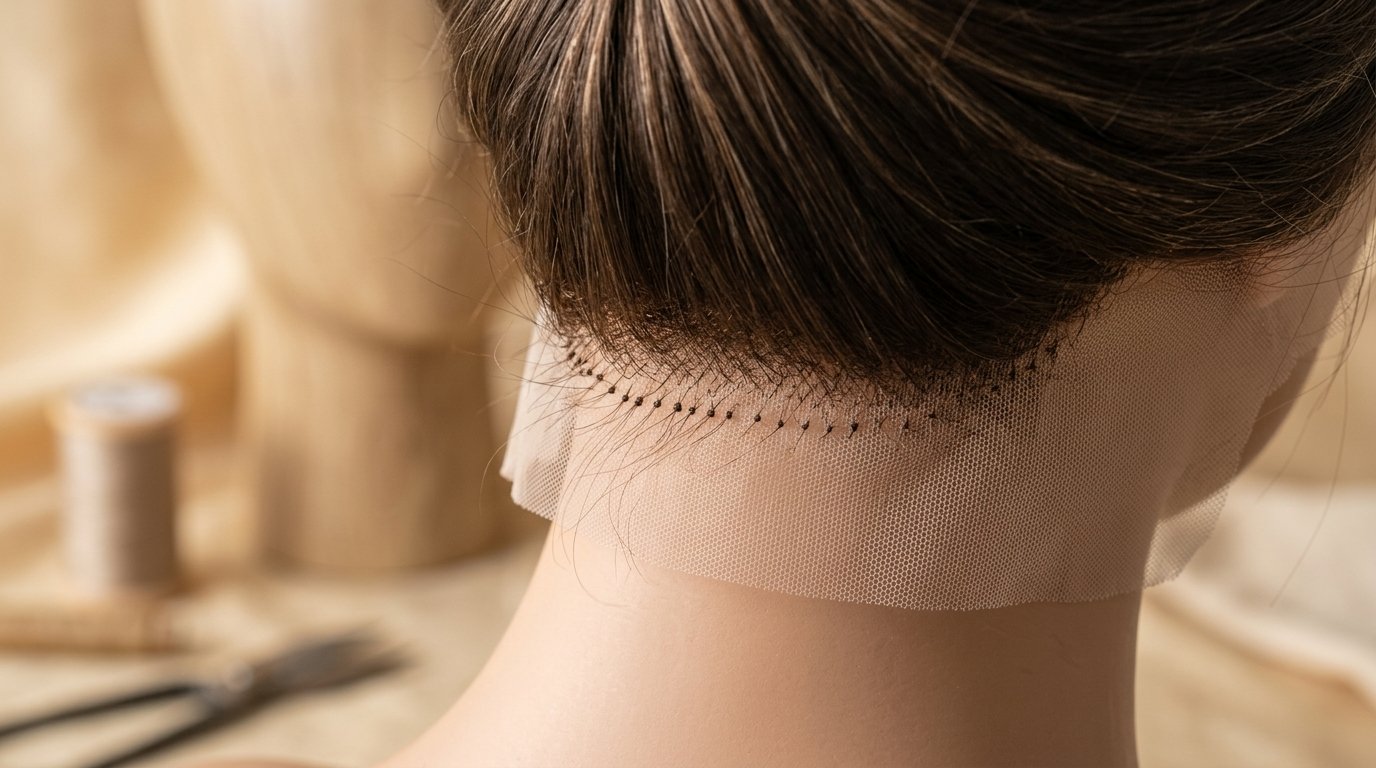
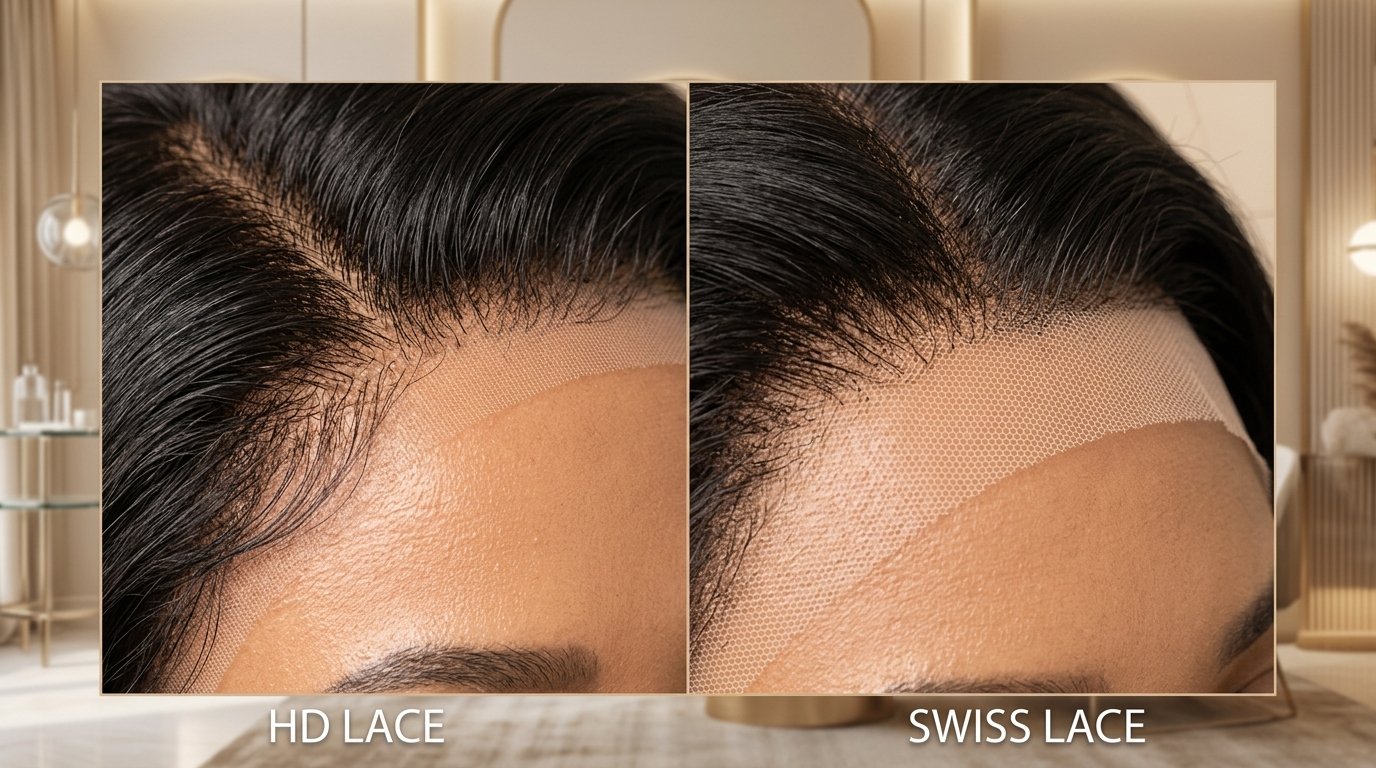
- Touching Hot Tools to Lace: A flat iron plate running at 350°F will melt Swiss lace or HD lace in less than a second. Keep hot tools at least an inch away from the delicate lace knots.
- Using Hot Combs on Synthetic Blends: If your wig was mixed with cheap synthetic fibers to cut costs, a 400°F hot comb will instantly melt those fibers into a sticky, blackened plastic glob. Authentic raw hair never melts.
- Skipping Sectioning: Trying to iron giant two-inch thick chunks of hair forces you to clamp down with crushing pressure, scorching the outer layer while the inner layer stays wavy.
- Styling Dirty Hair: Never flat iron hair that's coated in old edge control, hairspray, or heavy grease. The heat cooks those oils into a crusty lacquer that glues cuticle scales together and snaps strands off at the root.
- Storing Wigs While Hot: Never throw a freshly curled or ironed wig into a drawer while the strands are still warm. Keratin needs time to cool down completely to set its shape. Let it cool on a wig head for fifteen minutes.
The Silky Fusion Heat Checklist: Safe Everyday Styling
Follow this exact checklist before turning on your styling tools:
- ✓ Hair is 100% bone-dry from roots to tips.
- ✓ Light silicone-based heat protectant applied evenly.
- ✓ Iron temperature set between 300°F and 340°F (never above 370°F).
- ✓ Hair sectioned into thin slices no wider than your comb teeth.
- ✓ Comb-chase technique used for a single, continuous, fluid pass.
- ✓ Hot tools kept safely clear of lace knots and delicate hairline edges.
Respect the heat, and your raw hair systems will look flawless for years.