The Nape Matting Paradox: Why Raw Hair Tangles at Your Neck
There's nothing more frustrating than a luxury wig that mats at the neck.
You can brush it out until it's completely smooth, walk around for two hours, and find another massive tangled knot waiting at your nape. Naturally, most women assume they got scammed with cheap synthetic hair or processed floor waste.
Here's the ironic truth: cheap acid-bathed hair often doesn't mat at the nape during the first week.
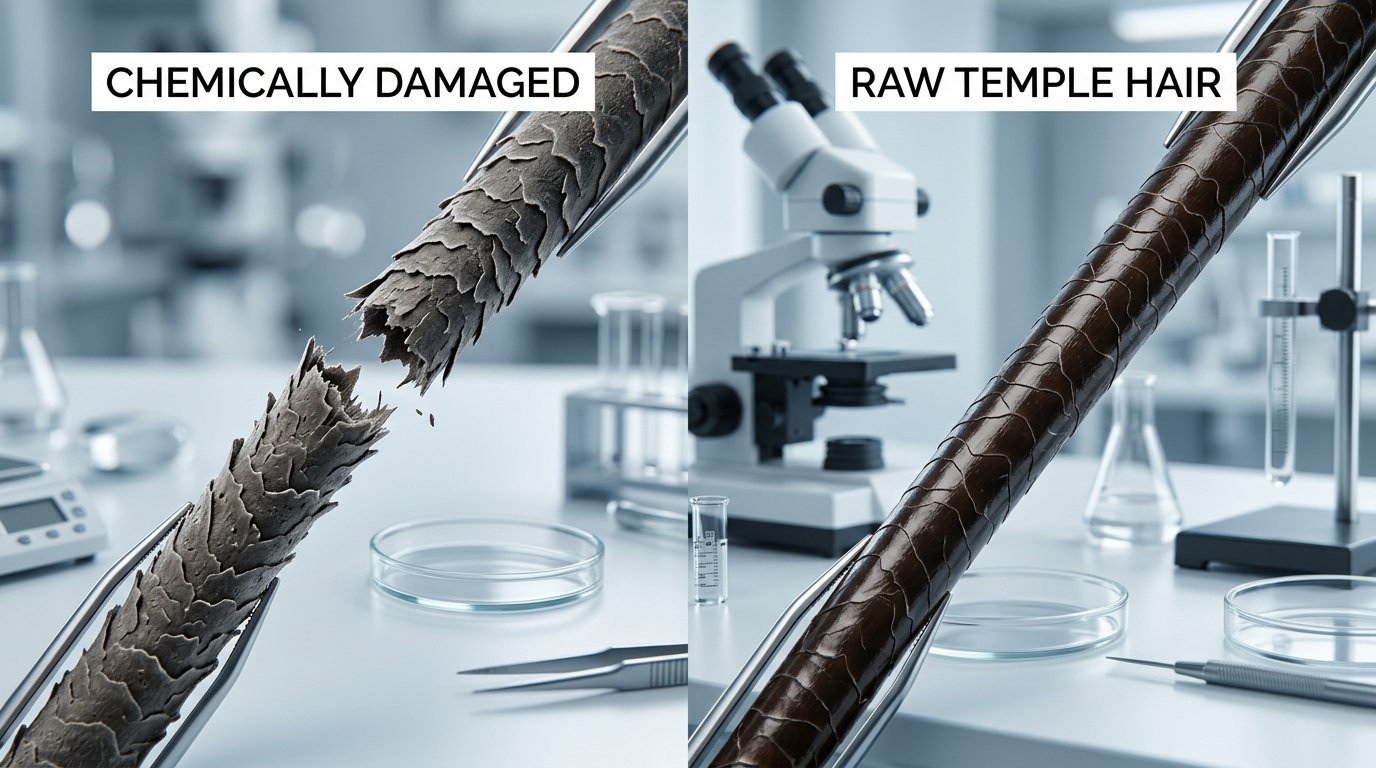
Why? Because cheap hair has had its cuticles burned off with hydrochloric acid and coated in thick silicone grease. There are no cuticles left to catch against each other.
When you have authentic raw Indian hair, every single strand retains its sharp, active, shingle-like keratin cuticles. When those cuticles rub against each other the wrong way, they catch with incredible force. The problem isn't the quality of your hair—it's the mechanical geometry of hand-tied knots.
Hand-Tied Knot Geometry: What 'Return Hair' Actually Is
How do wigmakers ventilate hair into lace?
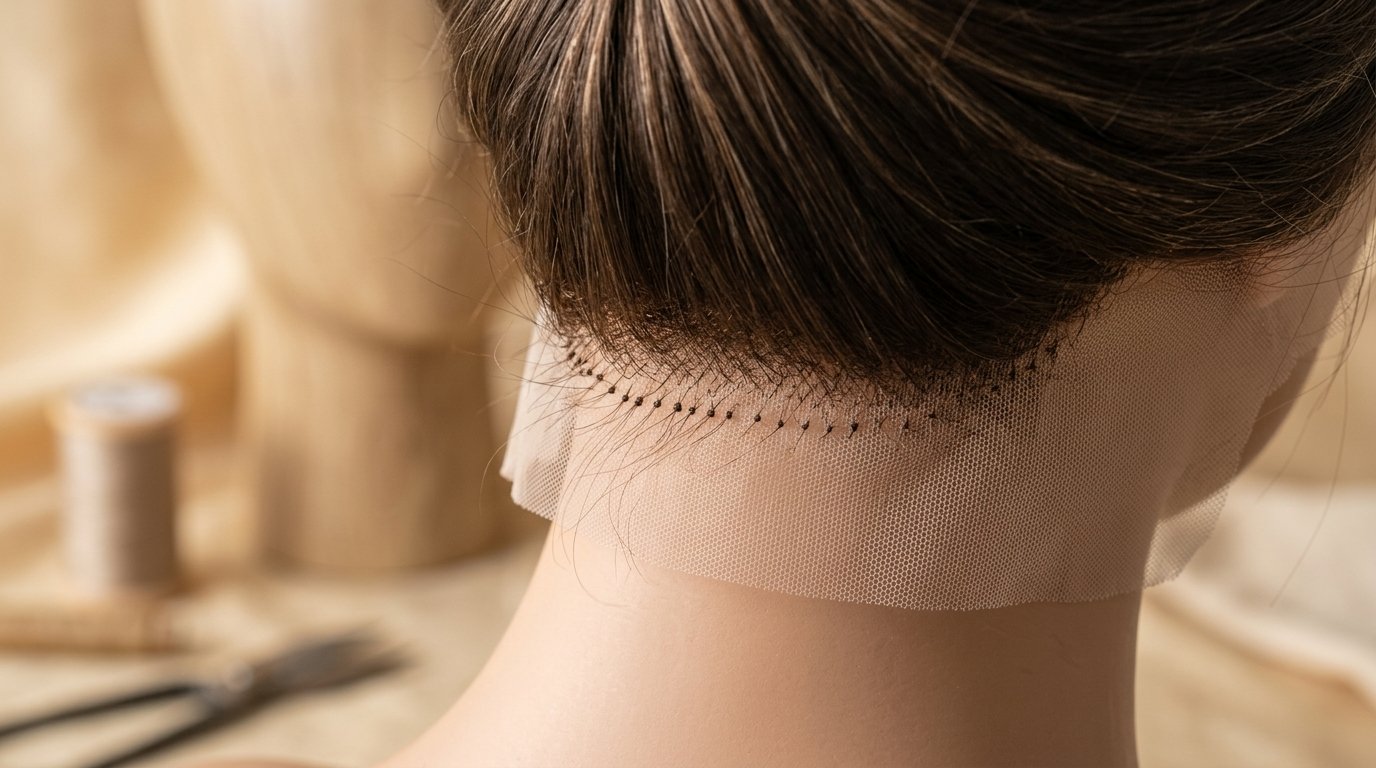
They don't glue strands in place. They use a tiny ventilating needle to loop hair around the lace threads and tie a knot.
To tie a knot, the artisan takes a strand of hair, loops it through the mesh, and pulls the long side through. But you can't tie a knot without leaving a short 'tail' on the other side. That's just basic knotting physics. In wigmaking, that short tail is called the return hair (or fold-over hair).
On most commercial wigs, these return hairs are two to four inches long, sticking out around the base of every single knot across the cap.
Reverse Cuticle Friction: The Microscopic Velcro Effect
Here's where biological physics creates a massive problem.
Hair cuticles are shaped like roof shingles or pinecone scales. On the main shaft of raw Remy hair, all the cuticle scales point downward toward the tips. That's why running your fingers downward feels silky and smooth.
But think about the return hair.
Because that two-inch tail was folded backward to form the knot, its cuticles are pointing upside down. The cuticles on the return hair point upward toward the roots.
Now you've got thousands of short, stiff return hairs with upward-pointing cuticles mingling directly with long body hairs that have got downward-pointing cuticles.
Whenever those two opposing cuticle directions slide against each other, the scales interlock like microscopic Velcro teeth. The more they rub together, the tighter the knot locks. That's what creates stubborn nape dreadlocks. It really does.
The Cuticle Friction Coefficient
Parallel cuticle sliding has a friction coefficient of μ ≈ 0.15. But opposing, inverted cuticle sliding increases friction to μ ≈ 0.65—over a 400% surge in mechanical resistance, making spontaneous knotting almost guaranteed under continuous movement.
The 4 Mechanical Friction Vectors Around Your Neck
Why's this matting happen almost exclusively at the nape and rarely at the crown?
Because the nape of your neck's an intense mechanical war zone:
- Continuous Cervical Head Rotation: You turn your head left and right hundreds of times an hour. Every turn grinds the nape hairs back and forth against each other.
- Garment Collar Abrasion: Wool sweaters, polyester jacket collars, and cotton hoodies rub continuously against the back of your hair, generating static electricity that fluffs cuticles open.
- Perspiration Salt Crystals: The nape is one of the sweatiest spots on your body. Sweat contains sodium chloride (salt). As sweat evaporates, tiny sharp salt crystals form on the hair shaft, acting like coarse sandpaper that shreds protective lipid coatings.
- Thermal Heat Trapping: Body heat rises up from your neck and gets trapped beneath the heavy hair layer, softening keratin bonds and making strands more prone to crimping and kinking.
Workshop Solutions: Micro-Shearing & Knot Sealing
In our medical and luxury prosthesis workshop, we refuse to let clients deal with nape matting.
Here's how master craftsmen eliminate return hair friction at the bench:
- Micro-Shearing Return Hairs: Using precision curved surgical ventilating shears, we carefully trim the return hair tails along the nape down to less than three-quarters of an inch. By keeping them ultra-short, they can't whip around or tangle into the long body hair.
- Single-Strand Micro-Knots: We avoid chunky double knots at the nape. By tying ultra-fine single micro-knots with just one or two hairs per pore, the return hair diameter is microscopic and pliable.
- Polyurethane Nape Lining: Along the bottom half-inch of the nape contour, we often use a whisper-thin polyurethane skin lining instead of exposed lace. Hair is injected into the skin without return hairs, meaning there are zero inverted cuticles touching your neck.
The Wearer's 5-Point Daily Prevention Protocol
If you're wearing a standard hand-tied wig at home, you can stop nape matting by following these five daily rules:
- Silicone Serum Boundary Layer: Before putting your wig on, apply two drops of pure dimethicone or argan oil exclusively to the bottom three inches of the nape hair. The lightweight silicone coats the cuticles, creating an artificial slip barrier that stops scales from catching.
- Wear Silk or Satin Collars: When wearing a wig with your hair down, avoid rough wool turtlenecks or coarse polyester jackets. Wear silk scarves or smooth satin collars around your neck to cut fabric friction by 80%.
- Midday Brush Breaks: Keep a wide-tooth carbon fiber comb in your purse. Spend ten seconds gently combing through the nape section every three hours to untangle loose fibers before they lock into felted mats.
- Sleep on Pure Mulberry Silk: If you wear your piece overnight, never sleep on a cotton pillowcase. A 22-momme pure silk pillowcase lets your neck glide effortlessly without friction drag.
- Use Knot Sealer Spray: Lightly mist the underside of your nape lace with a dedicated acrylic knot sealer once a month. It seals knot roots and stops return hairs from shifting.
Emergency Untangling Protocol (Without Snapping Hairs)
What should you do if your nape's already formed a tight, stubborn knot?
Don't ever grab a brush and yank it from the top down. You'll snap hundreds of hairs mid-shaft and create permanent frizz.
Follow our gentle workshop detangling method:
- Saturate the matted section with warm water and a generous pump of slippery silicone conditioner (or jojoba oil).
- Take a metal rat-tail comb and use the sharp metal tip to gently pick apart the knot from the bottom-most edges, strand by individual strand.
- Work your way slowly upward toward the base of the cap. The conditioner provides slip so cuticles slide past each other without snapping.
- Once the knot is loose, rinse thoroughly with cool water and let the hair air-dry flat.
The Silky Fusion Standard: Anatomical Nape Engineering
At Silky Fusion, we don't treat the nape of a wig as an afterthought. We engineer it with the highest precision in the industry.
Every custom hair system we craft features hand-trimmed micro-returns, inverted cuticle neutralizing washes, and soft ergonomic nape contours that flex naturally with your neck. You can dance all night, wear warm coats, and turn your head with total freedom—without ever worrying about a tangled mess at the back of your neck.
That's what genuine craftsmanship is all about. Flawless beauty from the front hairline all the way down to the nape.