Scalp Biology: Why Hair Grows in Natural Spirals
Look at a newborn baby's head. You'll notice something amazing right away: hair doesn't sprout straight up like needles in a pincushion. It really doesn't.
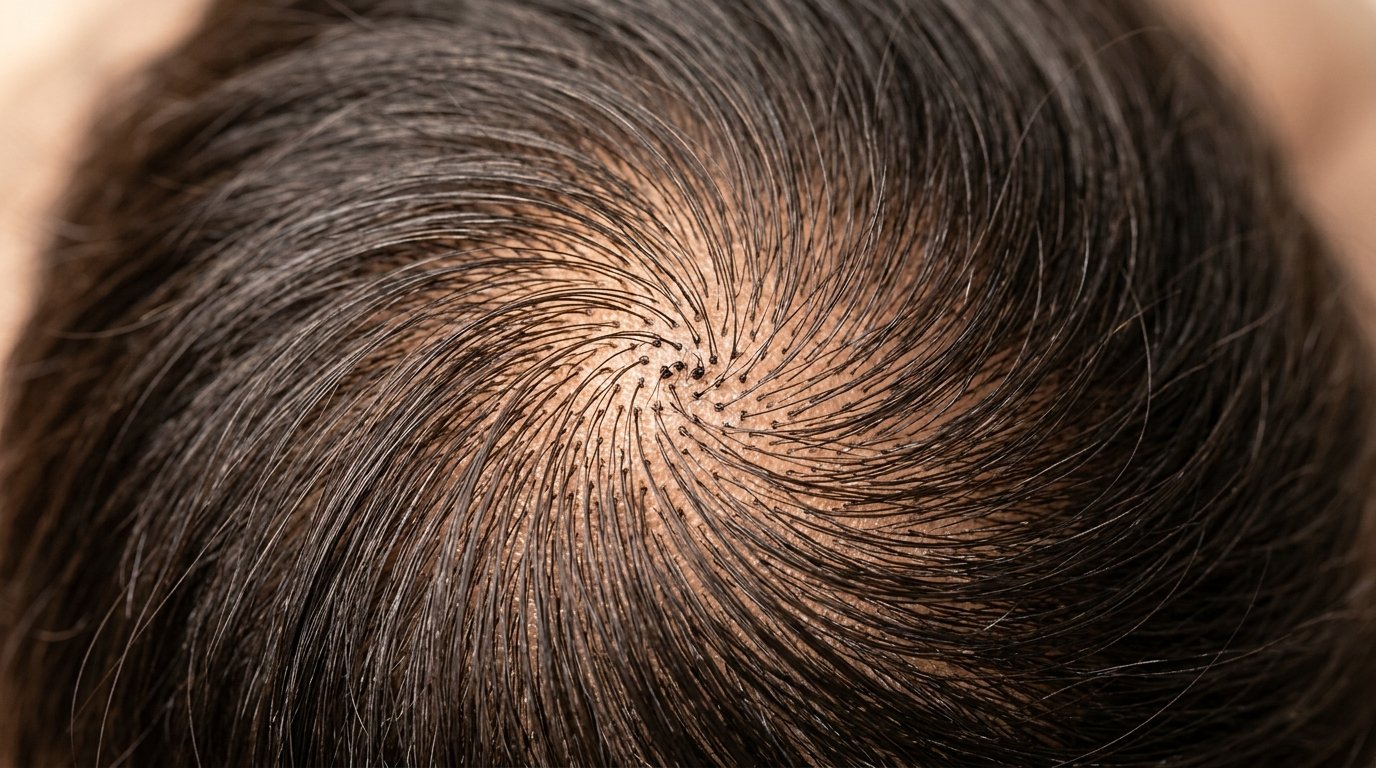
Every single hair follicle on your head grows out of the scalp at a sharp, diagonal angle—usually between 30 and 50 degrees. And right at the vertex—the crown at the back top of your head—those follicles organize into a natural spiral swirl called the parietal whorl. That's how nature built us.
Why did nature design our hair that way?
Evolutionary biology. When rain falls on your head, that spiral swirl channels water downward in smooth streams around your skull instead of letting it puddle on top. Even more importantly, that diagonal angle gives hair its natural spring. As hairs emerge sideways in a curve, they create natural lift and bounce, giving the crown soft, airy fullness. You can't beat biology.
When cheap factory wigs ignore this biology and stitch machine wefts in flat, straight rows across the top, the result is an instant giveaway. The hair lies completely dead and flat like wet cardboard, or stands straight up in a stiff ridge. Anyone standing behind you knows in two seconds that it's a wig. You don't want that kind of attention.
Clockwise vs Counter-Clockwise: The 90% Rule
Human crown swirls aren't random. They follow clear genetic patterns that you've probably never noticed:
- Clockwise Swirls: About 85% to 90% of the world's population has a clockwise crown swirl. The hair starts at an off-center point and spirals clockwise, sweeping smoothly from the left crown across the top toward the right side. It's the most common pattern by far.
- Counter-Clockwise Swirls: About 10% to 15% of people have a reverse swirl that rotates counter-clockwise.
- Double Swirls: A small percentage of people have two adjacent crown swirls, which creates a natural, stubborn cowlick where the two spirals collide. We've mapped dozens of these for clients.
- Off-Center Placement: On more than 75% of real heads, the swirl doesn't sit dead-center. It sits about an inch to the left or right of the midline. That's real human anatomy.
Now look at cheap factory wigs. Almost every single one has a stamped-out circle placed dead-center on the cap. If your natural face shape and parting habits are built for an off-center clockwise swirl, wearing a dead-center factory cap feels unnatural. The hair continually fights your face, splits open at the back, and exposes the lace base underneath. It's frustrating, and you don't need to put up with it.
Grand Central Station: How Crown Hair Flows into 4 Zones
Think of the crown as the central traffic roundabout on your head. From that one small swirl, hair flows outward in four completely different directions. It's fascinating how it works:
- Forward Flow: Hairs from the front of the swirl flow forward across your crown, gradually merging into your parting line and front hairline.
- Left & Right Cascades: Hairs on the sides curve smoothly downward over your ears. If this transition is too bulky, you'll get weird, puffy ridges above your ears. You don't want that bulk.
- The Back Fall: Hairs exiting the rear of the swirl fall straight down your neck toward your shoulders. This section carries the most weight and friction from clothing collars. That's where tangling starts if it isn't ventilated properly.
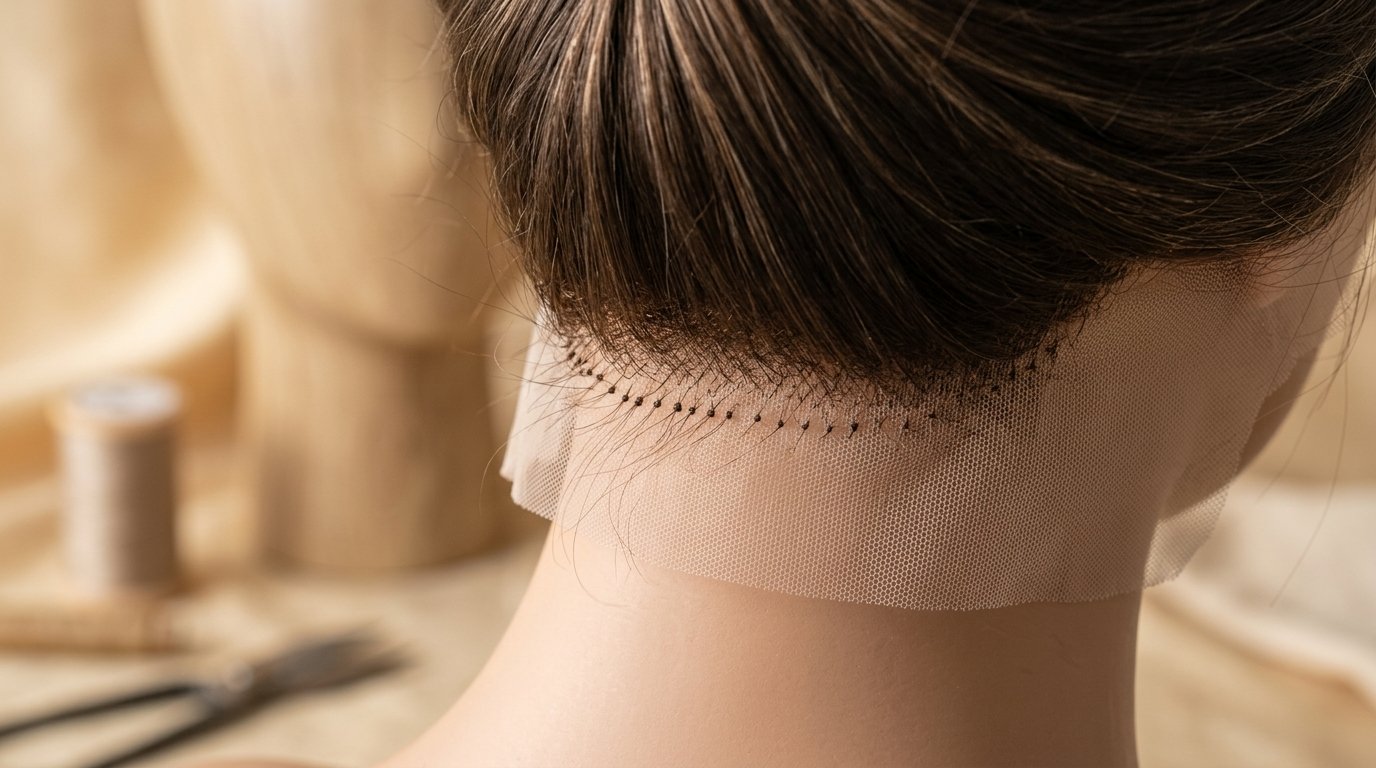
In custom wigmaking, an artisan must hand-tie those transition zones with gradual, microscopic shifts in angle. If a worker makes a sharp 90-degree jump in direction, the hair separates into an ugly vertical crack—what stylists call a 'trough'—that flashes bare lace every time you move your head. Gradual hand-knotting stops that crack from ever forming. It really makes all the difference.
Knot Angles: French Silk Tops vs HD Lace Mesh
How hair is anchored to the base material dictates whether the crown looks like growing hair or a stitched toupee:
French Silk Tops (The Gold Standard for Crowns)
A silk top uses three layers of material. Hairs are knotted into a base lace layer, and then individual strands are hand-threaded upward through a layer of flesh-toned Swiss silk. The knots stay hidden underneath the silk layer completely. When you look down at a silk top crown, you see zero black knots, zero grid lines, and zero glue. The hairs look like they're sprouting straight out of human skin pores. It's completely undetectable even from six inches away.
HD Lace Crowns
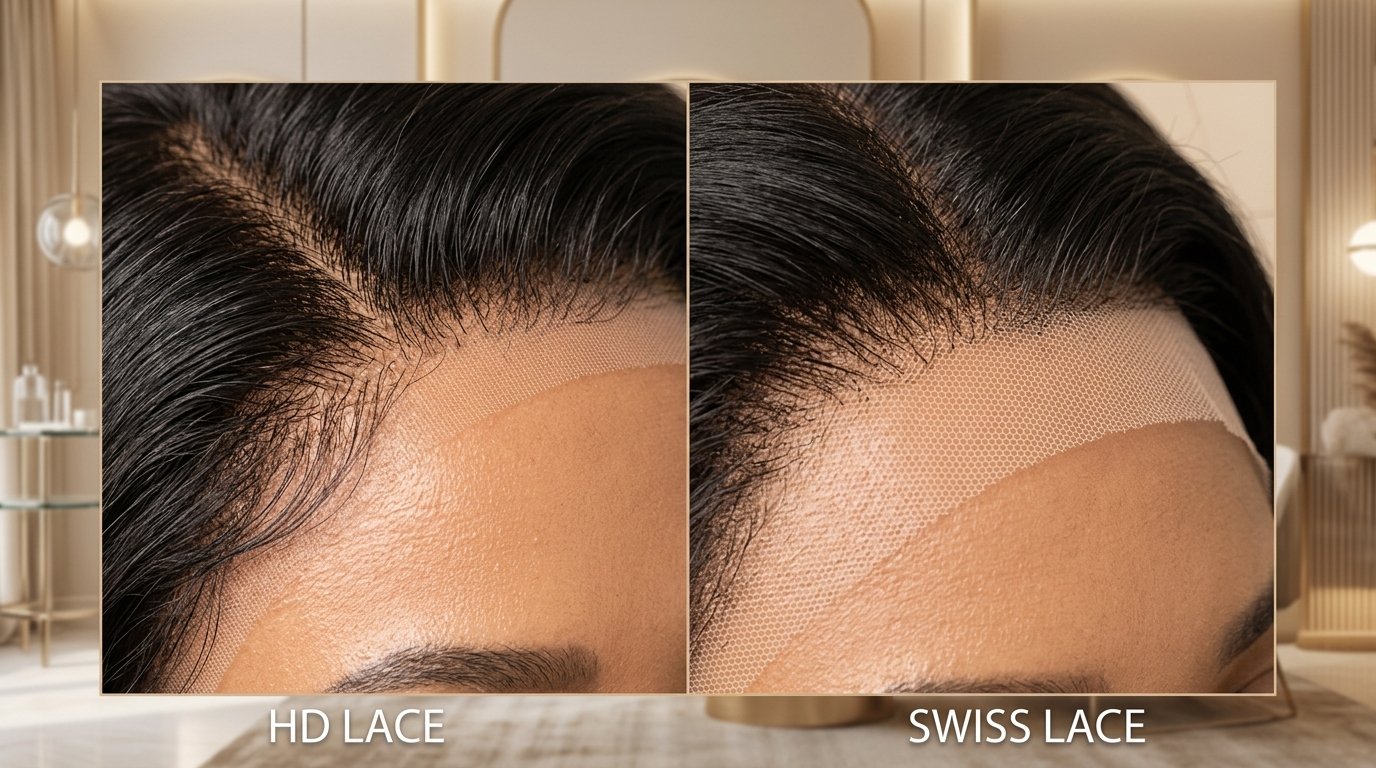
HD lace is ultra-thin and melts into the skin. But because HD lace is a single transparent mesh, the knots are visible if they aren't bleached properly. For the crown area, master artisans use single micro-knots (one single hair strand per lace hole) to keep the knots virtually invisible without requiring harsh bleaching chemicals that weaken the hair root.
| Crown Base Type | Knot Visibility | Natural Swirl Realism | Durability | Best Use Case |
|---|---|---|---|---|
| Triple-Layer French Silk Top | 100% Invisible (Knots hidden beneath silk) | Exceptional; mimics biological skin pores | Very High (Knots shielded from friction) | Luxury bespoke wigs, toppers & medical hair loss |
| Single Micro-Knot HD Lace | Near-Invisible when bleached lightly | Great; ultra-thin, breathable mesh | Medium (Delicate 20D lace mesh) | Frontal crowns, summer wear, lightweight units |
| Machine Weft Circular Crown | High (Exposed stitching & thick tracks) | Awful; stiff bicycle-wheel spoke effect | High brute strength | Budget costume wigs only; avoid for daily wear |
Natural Lift: Why Flat Crowns Look Like Helmets
Have you ever seen someone wearing a wig where the hairline looks great, but the back of the head looks like a flat helmet?
That happens when a wig has zero natural crown lift.
On a real human head, crown hairs emerge at that diagonal 45-degree angle, creating an internal air pocket beneath the strands. That gives the back of your head a soft, rounded, elegant profile. When factories machine-stitch wefts flat against a cap, they eliminate that air pocket completely. The hair lies plastered against the skull, creating that dreaded flat-head look that ruins your entire silhouette.
The Bicycle-Wheel Trap: Cheap Factory Machine Crowns
In low-cost commercial hair factories, speed is everything. Workers don't have hours to hand-tie individual hairs in a graceful spiral.
Instead, they take a circular piece of lace and machine-stitch hair in straight lines radiating outward from a single center point. Stylists call this the bicycle-wheel defect.
Every single strand points straight out like a bicycle spoke. When you look at it from above, there's a dead, empty circle in the middle surrounded by a rigid ring of hair. When wind blows, the hair parts into stiff, unnatural triangles that instantly betray the piece. Real hair never grows like spokes on a wheel.
Styling the Crown: Why Excessive Wax Ruins Natural Flow
When people struggle with a puffy or misbehaving crown, their first instinct is to grab a wax stick and an electric hot comb.
They cake heavy wax onto the crown and press it flat with 400°F heat. Yes, it lies flat for an hour. But you've just destroyed the natural movement of the piece.
Wax glues the hairs together into thick clumps. Instead of individual strands floating and swaying naturally with your head movements, the entire crown moves as one stiff, solid block—like a plastic lego hair piece. To train a crown properly, use light water mist, a round vent brush, and low blow-dryer heat. Never suffocate your crown in heavy wax.
Matching Your Cowlick: Hand-Tying to Your Natural Pattern
If you're wearing a hair topper to blend with your natural hair, matching your natural crown swirl is non-negotiable.
If your bio hair naturally swirls clockwise from the left side, and your topper has a counter-clockwise swirl on the right side, the two patterns will collide behind your head. They will push against each other, creating a permanent tangled bird's nest that pops out no matter how many bobby pins you use.
When ordering a custom topper, take a clear photo of the back of your head under bright daylight. A master wigmaker will map your exact cowlick location and ventilate the topper to mirror your natural swirl direction flawlessly.
Three Dead Giveaways: The Bullseye, Black Knots & Bald Voids
Check your hair systems for these three common crown flaws:
- The Bullseye Knot Ring: In cheap lace wigs, factories tie large double-knots with three to four dark hairs per knot right at the crown center. It looks like a ring of black pepper flakes on your scalp. Always demand single micro-knots or silk tops for the crown area.
- The Bald Center Void: Some factory crowns have an empty, hairless patch in the center of the swirl that's wider than a coin. A real natural crown swirl is tight—the spiral originates from a tiny point no bigger than the tip of a sharpened pencil.
- The Stiff Mohawk Ridge: When hairs from the left and right sides are ventilated pointing toward each other, they collide in the middle and stand up in a stiff, peaked ridge that looks like a faux-hawk.
The Silky Fusion Method: Hand-Mapped Micro-Knot Swirls
At Silky Fusion, we treat the crown like a work of fine art.
Every bespoke wig and luxury hair system we build features a hand-mapped crown swirl. Our artisans use single micro-knots on ultra-fine Swiss lace or triple-layer French silk. We hand-tie each strand in a natural anatomical spiral, matching your specific clockwise or counter-clockwise growth pattern.
When you walk under direct sunlight or stand on an escalator, there are no dark knot rings, no bicycle-wheel spokes, and no flat spots. Just soft, airy, beautiful hair that moves exactly like real growing hair.
True luxury is in the details you never have to worry about.