The 'Glue-Free' Mirage: Why Glueless Wigs Still Cause Hair Loss
For the past five years, the entire hair industry's waged war on lace adhesives.
And for good reason: cheap acrylic glues ripped out countless edges when they weren't removed properly. So when 'glueless wigs' arrived on the market, women breathed a massive sigh of relief. No more sticky pastes. No more alcohol removers. Just throw on a cap with an elastic band and walk out the door.
It sounded like the ultimate edge-saving miracle.
Except dermatologists are now treating thousands of women suffering from severe traction alopecia who haven't touched a bottle of lace glue in three years. Their temporal edges are completely bald, smooth, and scarred over.
How did a 'safe' glueless wig destroy their hair?
Because they swapped chemical damage for mechanical crushing. A wig's got to hold onto your head somehow. If it isn't using adhesive, it's using tight elastic tension. And if that elastic band's poorly designed, it puts relentless, concentrated pressure right on your finest baby hairs.
Elastic Fulcrum Physics: The 3-Pound Crushing Force on Your Temples
Let's look at the basic mechanical physics of a standard glueless wig.
Most commercial glueless caps use a thick elastic band sewn from one temple, around the nape, to the other temple. When you cinch that strap tight so the wig won't fly off in the wind, where's all that clamping force going?
It acts like a tourniquet. It creates a high-pressure mechanical fulcrum right over your temporal bones—that's the exact spot where your finest edge hairs live.
In our workshop testing lab, we've measured the continuous clamping pressure of standard commercial glueless bands. Many of these bands exert between 2.5 and 4 pounds of concentrated lateral force directly onto a half-inch strip of scalp skin. You're wearing a tight rubber tourniquet clamped against your baby hairs for ten to twelve hours a day. There's no hair follicle on earth that can survive that.
The Tourniquet Effect
Continuous mechanical compression above 32 mmHg (capillary blood pressure) cuts off micro-circulation to hair dermal papillae. When blood flow drops, follicles starve for oxygen and nutrients, initiating rapid miniaturization.
Anatomy of Follicle Death: Blood Supply Choking & Papilla Shear
Your hair follicles aren't dead wires. They're delicate living mini-organs embedded inside your scalp tissue.
At the base of every single follicle sits the dermal papilla—that's a microscopic cluster of cells fed by tiny capillary blood vessels. This capillary blood supply delivers the oxygen, iron, and amino acids required to produce keratin protein.
When a tight elastic band presses down on your temple for eight hours straight, it physically compresses those tiny capillaries flat. Blood flow slows to a crawl. The follicle's essentially choked of oxygen.
Even worse is dynamic shear friction. Every time you turn your head, talk, or walk, that tight elastic band shifts microscopically back and forth across your scalp. That back-and-forth friction creates a pulling shear force on the hair bulb, literally tearing the living follicle away from its dermal anchor. After months of this trauma, the follicle gives up, enters permanent dormancy, and develops fibrous scar tissue. Once a follicle's scarred over, hair can't ever grow back naturally.
Pressure Necrosis vs Traction Pull: Two Ways Bands Kill Edges
Glueless wigs attack your hairline through two distinct biological mechanisms:
1. Direct Pressure Necrosis
This is caused by downward crushing force. The elastic band presses the hair shaft flat against the hard bone of your skull. Over time, that constant crushing force damages the epithelial cells in the root sheath, causing hair to shed with white keratin bulbs attached. If left unchecked, it causes localized pressure necrosis—tiny tender, red indentations along the hairline where hair refused to grow back.
2. Dynamic Traction Pulling
This happens when you adjust the wig, pull it backward, or style it into high updos. If the wig has small interior metal combs that dig into your bio hair, every step you take exerts a continuous backward pulling tension on your roots. That constant pulling force rips the hair shaft right out of the follicle bulb.
| Wig Attachment Style | Primary Risk Mechanism | Where Damage Strikes First | Safe Wear Time |
|---|---|---|---|
| Tight 2-Point Elastic Band | Capillary choking & localized pressure necrosis | Temporal peaks & above the ears | Max 4–6 hours without relief |
| Interior Metal Clips / Combs | Sharp tensile tearing & root snapping | Front hairline & crown anchor points | High risk; avoid clipping into fine edges |
| Bespoke 3D Contoured Cap (Silky Fusion) | Balanced weight distribution across skull curve | Zero localized pressure points | All-day comfort (12+ hours safely) |
| Medical Silicone Grip Band | Gentle friction grip without tension clamping | Dispersed evenly around perimeter | Safe for daily wear even on total hair loss |
The Tension Headache Alarm: What That 4 PM Throbbing Really Means
Do you get a dull, throbbing headache right above your ears or at the base of your skull around 3:00 or 4:00 PM when wearing your wig?
Don't ignore that headache. That's your body's emergency siren.
That pain isn't just everyday fatigue. It's sub-occipital neural compression. A tight perimeter band compresses the greater occipital nerves and temporal nerve branches that run right beneath your scalp skin. If a wig band's tight enough to compress nerves and give you a headache, it's applying more than enough crushing pressure to kill the delicate hair follicles trapped underneath. A properly fitted wig shouldn't ever cause even a hint of a headache.
Early Warning Signs: White Bulbs, Redness & Miniaturization
Traction alopecia doesn't happen overnight. It takes months of cumulative pressure. Check your hairline once a week under bright bathroom lighting for these three early warning signs:
- Redness and Folliculitis: Tiny red bumps, pimples, or tender red spots along your temporal hairline right where your wig band rests. That's acute inflammation of the follicle opening.
- The 'Fringe Sign': You notice that your baby hairs look thin, wispy, and pale, while the hair an inch further back remains thick and dark. That's follicle miniaturization—the blood supply has been choked down so much that the hair can only produce weak, peach-fuzz strands.
- Excessive Shedding with Bulbs: When you take your wig off at night, check the cap band. If you see dozens of hairs with clear white gelatinous bulbs attached, those hairs were ripped out of living follicles by friction.
The Metal Comb Trap: Why Interior Wig Clips Rip Out Hair Roots
Almost every mass-market wig comes with three or four tiny metal comb clips sewn inside the cap: two at the temples and one at the crown.
If you've got fine, delicate bio hair, cut those metal combs out immediately.
Those small metal teeth are hair executioners. When you slide those teeth into your fine edges and cinch the back strap tight, that metal comb acts like an anchor hook. Every time you turn your head, wind hits your wig, or you bend over, the entire 200-gram weight of the wig pulls directly on those few hairs trapped in the teeth. Within three months, you'll have bald, smooth quarter-sized patches right where the combs are anchored.
Ergonomic Cap Blueprint: Distributing Weight Across the Skull
So how do medical wigmakers build secure glueless wigs that don't pull on edges?
The answer's load distribution.
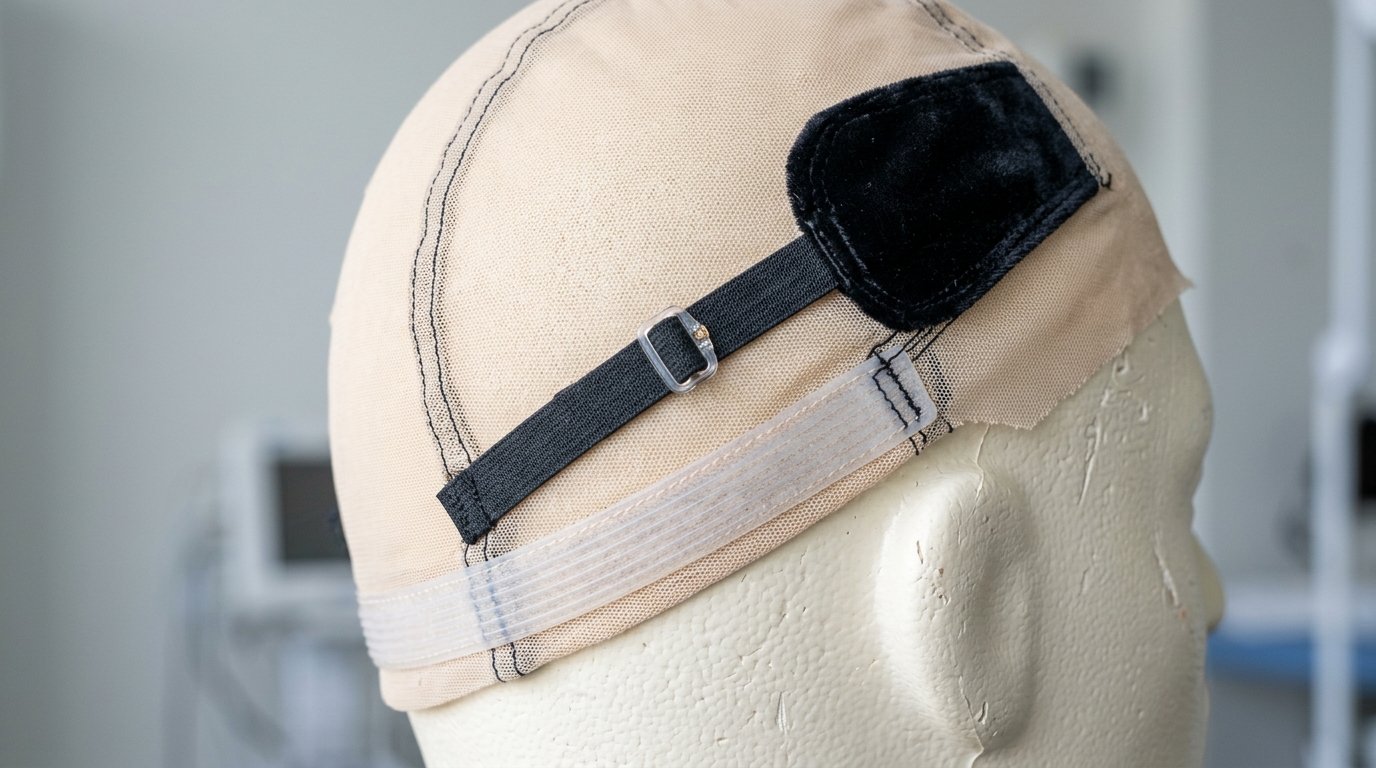
Instead of a tight two-point elastic band that clamps onto the temples, an ergonomic cap distributes the weight of the hair across the wide, sturdy parietal ridge—that's the solid bone plate across the top-back of your skull. The cap's tailored with anatomical darts so it hugs your head's 3D curve naturally, relying on shape matching rather than elastic constriction.
We've replaced harsh metal clips with wide, soft medical silicone grip panels. Silicone grips the skin or bio hair through gentle, micro-suction friction. It holds the piece rock-steady in outdoor wind, but exerts zero clamping tension on your edges.
Safe Wearing Rules: Band Width, Velvet Grips & Night Care
If you love wearing glueless wigs, here are five golden rules to protect your natural hair:
- Widen the Band: Don't ever use thin, half-inch elastic straps that act like piano wire. Use wide, soft 1.5-inch or 2-inch elastic bands that'll spread tension over a broad surface area.
- Wear a Bamboo-Velvet Grip: Wear a high-quality bamboo or velvet wig grip band underneath your cap. The velvet nap holds the wig firmly in place without needing tight elastic tension against your skin.
- Don't Sleep in a Glueless Unit: Take your wig off before bed. Sleeping in a wig forces the elastic band to grind against your edges as you toss and turn on your pillow all night long.
- Massage Your Scalp Nightly: After removing your wig, spend two minutes gently massaging your temples and hairline with your fingertips. That physical massage restores capillary blood circulation and relieves tissue tension.
- Give Your Edges Days Off: Wear loose headbands or take hair breaks on weekends so your follicles will recover completely.
The Silky Fusion Standard: Bespoke Weight-Balanced Foundations
At Silky Fusion, we believe luxury hair should protect your natural beauty, never compromise it.
Every cranial prosthesis and custom wig we build's engineered with true medical-grade ergonomics. We tailor our cap foundations directly to your 3D head measurements, incorporating breathable Swiss lace, pure silk linings, and gentle hypoallergenic silicone grip zones. The weight's balanced effortlessly across your skull, eliminating tension headaches and protecting your delicate edges completely.
Zero glue. Zero headaches. 100% protected edges. That's real ergonomic luxury.