The Ring Light Illusion: 1,500 Lux vs 100,000 Lux Midday Sun
Social media has completely warped our expectations of what an invisible lace hairline looks like in the real world.
Those viral transformation videos aren't filmed in normal daylight. They're shot in dim salon suites lit by 18-inch LED ring lights fitted with milky softbox diffusers. In that environment, light output measures between 1,200 and 2,500 lux of soft, scattered, omnidirectional illumination.
Step outside at 1:00 PM on a clear summer day, and the optical physics change completely.
Natural midday sunlight doesn't scatter softly. It bombards your forehead with over 100,000 lux of intense, collimated parallel light rays. That's a forty-fold increase in photon energy. At that intensity, every micro-shadow and plastic reflection gets amplified by a thousand percent.
If your lace was only tested under indoor beauty lights, sunlight will expose it in half a second.
Snell's Law: Skin (n=1.38) vs Nylon Lace (n=1.55)
Why does synthetic lace look like clear plastic when bright sunlight hits it?
It's all about Snell's Law of Refraction.
In physics, transparency is determined by the Refractive Index (n)—the speed at which light travels through a substance:
- Living Human Skin (Stratum Corneum): Composed of hydrated keratin cells and natural lipids, skin's got an optical refractive index between n = 1.38 and 1.42.
- Synthetic Polyamide / Nylon Lace: Extruded commercial nylon monofilament has a significantly higher refractive index of n = 1.53 to 1.58.
Whenever two touching materials have a refractive index difference greater than 0.10, light can't pass seamlessly across the boundary. Instead of traveling straight through the lace into your skin, incoming solar photons bounce backward off the nylon threads.
That reflected light creates an icy, grayish-white halo right across your forehead. That's the giveaway line. It doesn't matter how closely the lace tint matches your makeup tone—the physical material itself bends and reflects light differently than living human dermis.
Camera Sensor Smoothing: How Computational Filters Lie
Don't ever judge a lace installation through a smartphone camera lens.
Modern iPhone and Android camera sensors don't show raw optical reality. They use heavy computational photography pipelines. The software applies automatic edge-averaging, chromatic aberration correction, and dynamic range compression.
When the camera's image processor sees the fine 0.1mm grid of an HD lace border, it interprets that micro-grid as optical sensor noise. It literally averages adjacent pixel values, digitally blurring the lace boundary into the surrounding skin tones.
The human eye doesn't have an AI smoothing filter.
Human stereo vision possesses incredible depth perception and infinite dynamic range. When someone looks at you in person, their eyes don't blur pixels. They detect the subtle three-dimensional ledge and light reflection instantly. They really do.
Specular Glare vs Diffuse Scatter: Why Nylon Shines
There's another optical reason why lace flashes in sunlight: specular reflection. That's a huge factor.
Living skin's got microscopic pores, dermal ridges, and peach fuzz that create diffuse scattering. Light hits the skin and bounces off in thousands of random directions, giving human skin its soft, natural matte appearance.
Commercial HD lace, on the other hand, is made from smooth, cylindrical nylon monofilament fibers.
Because the nylon threads are extruded with smooth plastic surfaces, they produce specular reflection—light bounces off in a concentrated mirror-like beam. In bright sun, every horizontal lace thread flashes like a microscopic strip of fishing line.
The 4-Step Outdoor Daylight Neutralization Protocol
How do master theatrical wigmakers make lace disappear under unforgiving outdoor sunlight?
You've got to neutralize refractive mismatch and kill specular glare:
- Step 1: Alcohol-Activated Matte Tinting: Don't use oily cream foundations or liquid concealers to tint your lace. Oils increase specular shine. Use alcohol-activated theatrical pigment palettes (like Skin Illustrator). They dry completely matte and chemically bond to nylon fibers without adding grease.
- Step 2: Micro-Silica Light-Scattering Dust: After your lace adhesive sets, lightly dust the hairline with an ultra-fine, pure spherical silica translucent powder. Micro-silica particles settle between the nylon threads and scatter incoming solar rays, eliminating plastic shine.
- Step 3: Cut Along Natural Zig-Zag Paths: Don't ever cut your lace in a straight line across your forehead. Human hairlines aren't rulers. Use pinking shears or a razor to cut an irregular micro-scalloped zig-zag border that breaks up the continuous optical reflection line.
- Step 4: Density Gradient Plucking: Sunlight exposes harsh blunt edges. If your hairline jumps instantly from bare skin to 150% density, it casts a dark shadow underneath. You'll want to pluck a soft 60% to 90% transitional density gradient that lets sunlight filter through naturally.
Swiss Hexagonal Mesh vs Flat HD: How Texture Defeats Glare
A lot of people think thinner lace is always better. That's a total myth.
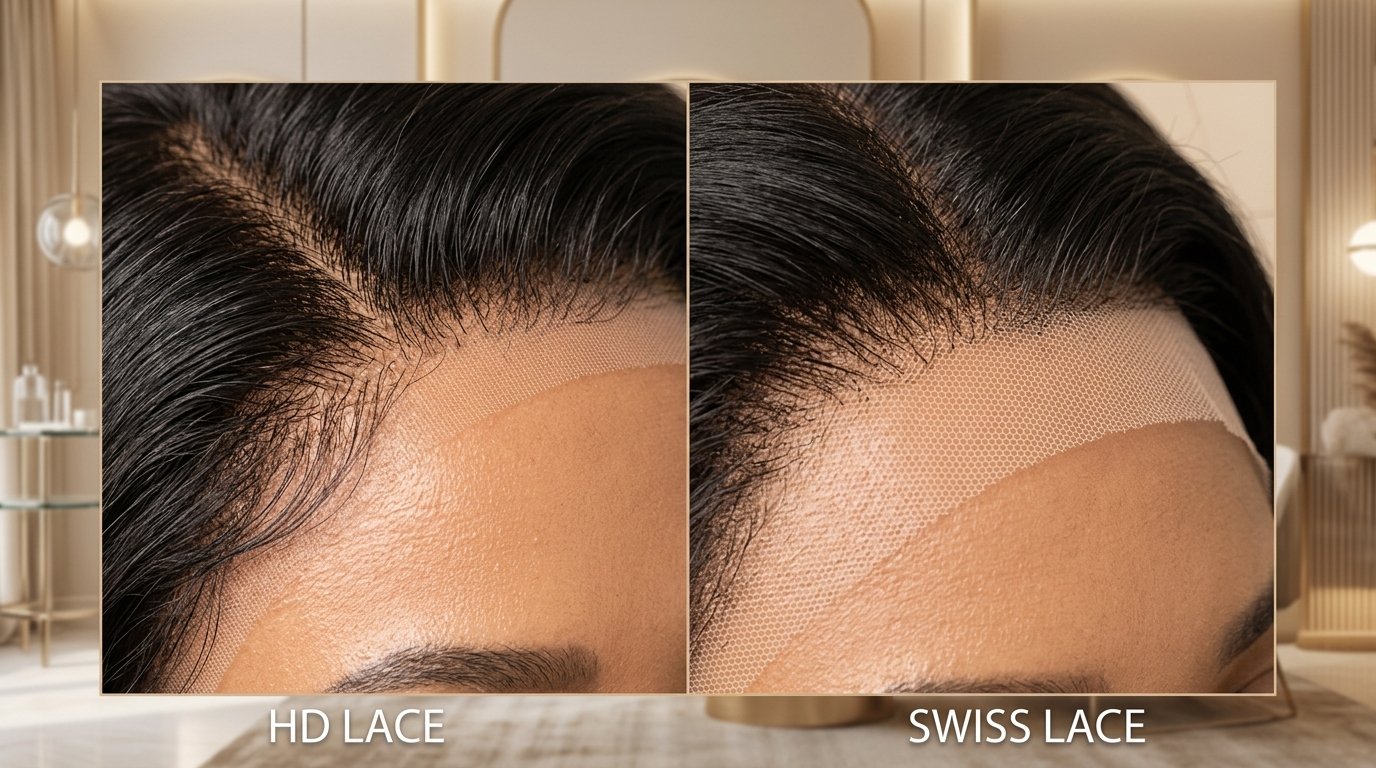
Cheap Chinese 'ultra-thin HD lace' is often rolled flat under heated rollers to make it thin. But flattening the threads creates smooth, mirror-like surfaces that flash horribly in daylight.
Authentic Swiss lace is woven with a microscopic three-dimensional hexagonal honeycomb structure. The threads have subtle organic surface texture. That microscopic roughness prevents specular glare, scattering sunlight softly just like real human skin. Under harsh noon sun, genuine Swiss lace frequently looks far more realistic than flat, shiny HD nylon. It really does.
The Silky Fusion Standard: 5500K Daylight Realism
At Silky Fusion, we don't build wigs for fifteen-second ring light videos. We build hair systems for real everyday life. You'll see the difference immediately.
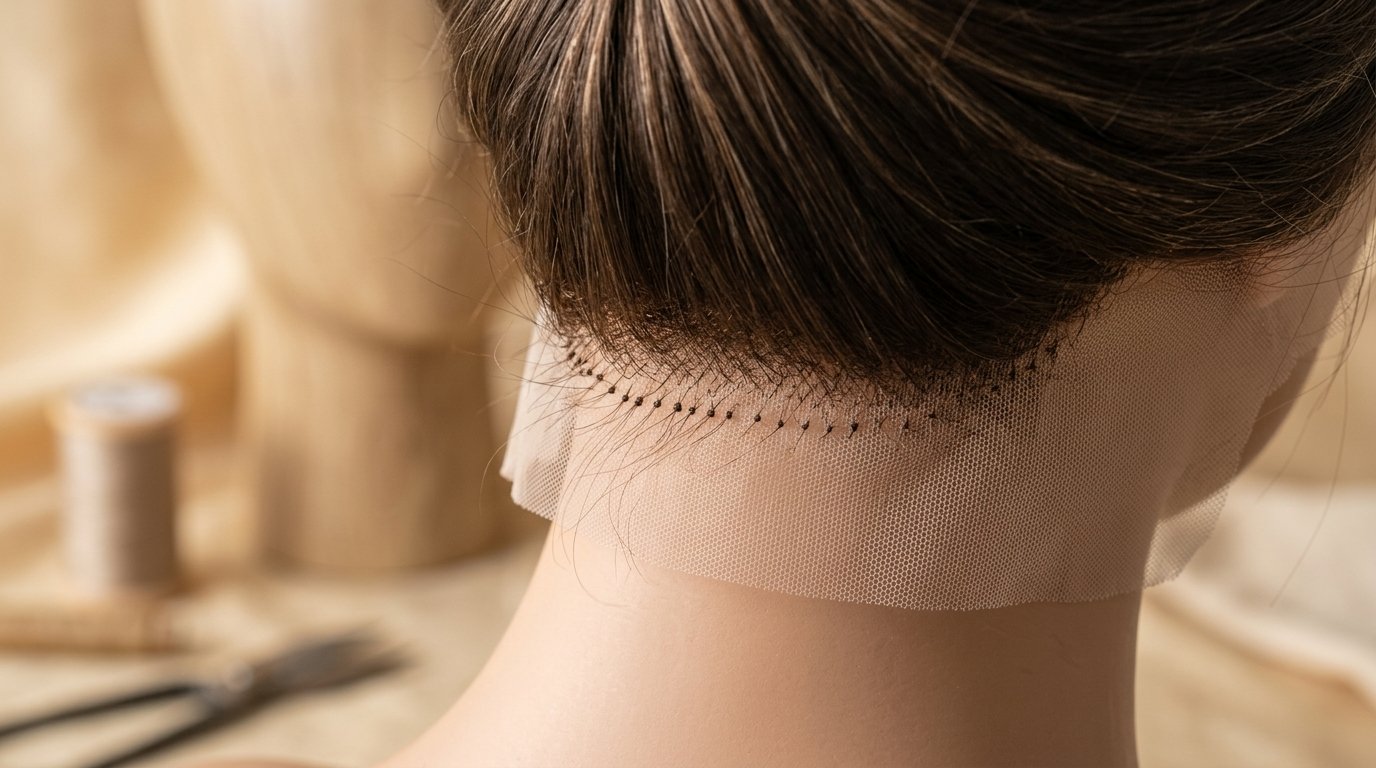
In our Chennai workshop, we inspect every custom hairline under 5500K color-calibrated daylight lamps that replicate real outdoor sun. We ventilate single hairs using micro-split knots, sculpt soft organic density transitions, and use authentic Swiss lace with zero plastic shine.
When you wear a Silky Fusion piece out into the bright midday sunshine, you don't have to look down or feel self-conscious. It looks like your own biological hair growing straight from your scalp. That's real craftsman confidence.