The Metro vs Suburban Water Mystery: Why Your Wig Turned Stiff
Every week, our workshop gets frantic messages from panicked clients:
'I washed my wig yesterday and it's completely ruined! The hair is stiff as cardboard, it won't curl, and it tangles instantly. Did you send me a bad piece?'
Our first question is always the same: where did you wash it?
Nine times out of ten, the client just moved to a new house outside a major metro, traveled to a coastal resort, or switched to unfiltered municipal tap water. In major cities, municipal water often comes from large surface reservoirs with low dissolved mineral content. But in suburban and rural areas across North America, Europe, and the Middle East, tap water is pulled from deep limestone aquifers packed with dissolved rock.
You didn't ruin your hair.
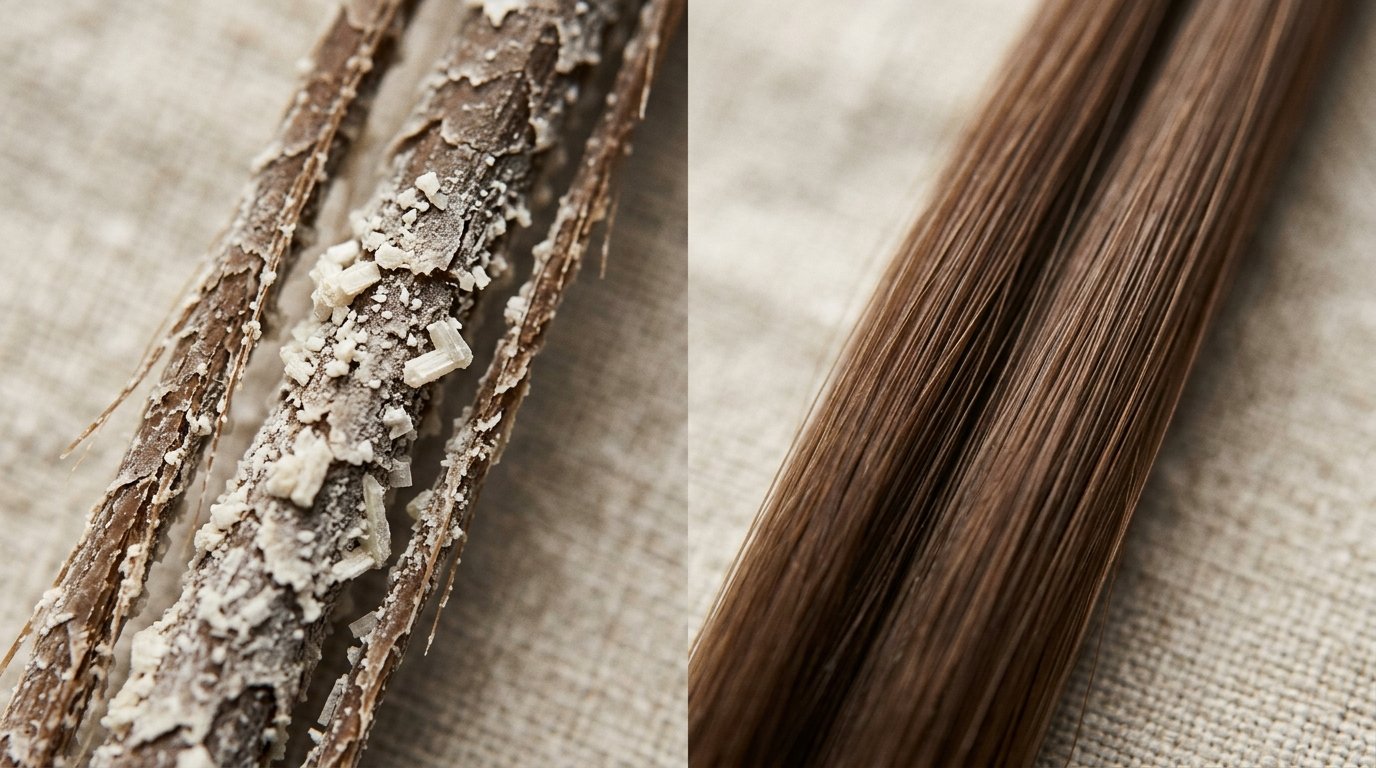
You literally coated every individual strand in microscopic limestone concrete.
The Missing Lipid Buffer: Why Wigs Suffer Far More Than Bio Hair
Why doesn't your natural biological hair turn into brittle straw quite as fast under the same tap water?
Because your scalp produces sebum. That's the secret.
Your living scalp secretes an acidic lipid mixture (pH 4.5 to 5.5) made of squalene, wax esters, and triglycerides. This natural oil continuously coats your bio hair, creating an oily, hydrophobic protective shield. When hard mineral ions hit your natural hair, your sebum mantle repels most of them, preventing direct mineral binding.
A wig doesn't have a living scalp.
It's got no sebaceous glands. There's zero natural oil being produced to buffer the keratin cuticle. Every single drop of mineral-heavy tap water hits bare, thirsty protein. Without an acidic lipid barrier, positively charged mineral ions grab onto the negatively charged keratin surface instantly. The calcification process happens three to five times faster on a wig than on natural hair.
The Chemistry of Calcification: Calcium & Magnesium Crusts
Let's look at what's actually happening on a microscopic level.
Hard water contains high concentrations of calcium cations (Ca2+) and magnesium cations (Mg2+) along with bicarbonate ions. When you wet your wig, the water swells the cuticle scales open.
As the hair dries on your wig stand, pure H2O evaporates into the air. But calcium and magnesium don't evaporate. They're left behind.
They react with atmospheric carbon dioxide and precipitate out as solid calcium carbonate (CaCO3) and magnesium carbonate (MgCO3) crystals. These microscopic rock crystals wedge themselves underneath your cuticle shingles and fuse across the surface of the hair shaft.
The result?
Your cuticle scales are locked permanently open by jagged mineral crystals. When strands rub together, the mineral crust grinds like sandpaper. The hair loses all light reflection (looking dull and gray), feels rigid and cardboard-stiff, and tangles at the slightest movement. It really does.
The Limestone Analogy
Calcium carbonate on your hair is the exact same chemical compound that forms stalagmites in caves and thick white limescale inside your electric kettle. You're trying to brush through kettle scale.
The Conditioner Trap: How Deep Masks Make It Worse
When someone's wig turns stiff, what's their natural instinct?
They grab the heaviest deep conditioning mask or hair oil they own and slather it all over the hair.
That's the worst thing you can possibly do.
Hair conditioners use positively charged quaternary ammonium compounds (cationic surfactants like cetrimonium chloride or behentrimonium methosulfate). When these conditioning polymers hit calcium and fatty acid residues on the hair, they don't soften the hair shaft. They react with the mineral salts to create an insoluble, sticky chemical glue that's called calcium soap scum.
Instead of silky movement, you've got a greasy, gummy film that's trapping more dirt and making the hair feel even stiffer. You can't condition your way out of a mineral problem. You've got to dissolve the rock first.
The 4-Step Professional Chelation Protocol
To restore your wig's original silkiness, you must use chelation—a chemical process where chelating agents wrap around mineral ions and pull them off the hair shaft into solution.
Here's our workshop-tested 4-step protocol:
- Step 1: The Acidic Pre-Soak (Dissolving Carbonate Crystals): Fill a clean basin with 2 liters of warm distilled or bottled water. Add 2 tablespoons of raw organic apple cider vinegar (or 1 teaspoon of food-grade citric acid powder). Submerge the hair (avoiding the lace foundation) for 15 minutes. The mild acid dissolves the alkaline calcium carbonate shell.
- Step 2: Chelating Shampoo Wash: Lather the hair with a professional chelating shampoo containing tetrasodium EDTA or sodium gluconate (such as Malibu C Un-Do-Goo or K18 Peptide Prep). Gently glide the suds from root to tip. Let the lather sit for 3 to 5 minutes so the chelator binds stubborn magnesium and copper ions.
- Step 3: Distilled Water Rinse: Rinse thoroughly using room-temperature distilled or reverse-osmosis bottled water. Don't rinse with the same hard tap water that caused the problem.
- Step 4: Lipid Barrier Restoration: Now that the cuticles are clean and free of rock crust, apply a pH-balanced (pH 4.0 to 4.5) acidic deep treatment mask rich in hydrolyzed silk proteins and lightweight argan or jojoba oil. Leave it on for 10 minutes, then do a final rinse with cold distilled water to lock the cuticles flat.
Everyday Prevention: Shower Filters & Distilled Rinses
Once you've restored your wig to liquid silk, protect it from calcifying again:
- Always Wash with Distilled Water: Buy a two-dollar gallon of distilled water from the supermarket for washing your high-end wigs. One gallon is enough to wash and rinse an entire 24-inch unit. It contains zero mineral ions.
- Install a KDF-55 Shower Filter: If you wash your hair in the shower, install a multi-stage shower filter containing KDF-55 and calcium sulfite media to neutralize chlorine and heavy metal ions.
- Weekly Acidic Refresh Spritz: Mix 1 teaspoon of apple cider vinegar into 8 ounces of distilled water in a spray bottle. Lightly mist the ends after styling to keep cuticles flat and maintain an acidic pH buffer.
The Silky Fusion Standard: Protecting Pure Temple Hair Cuticles
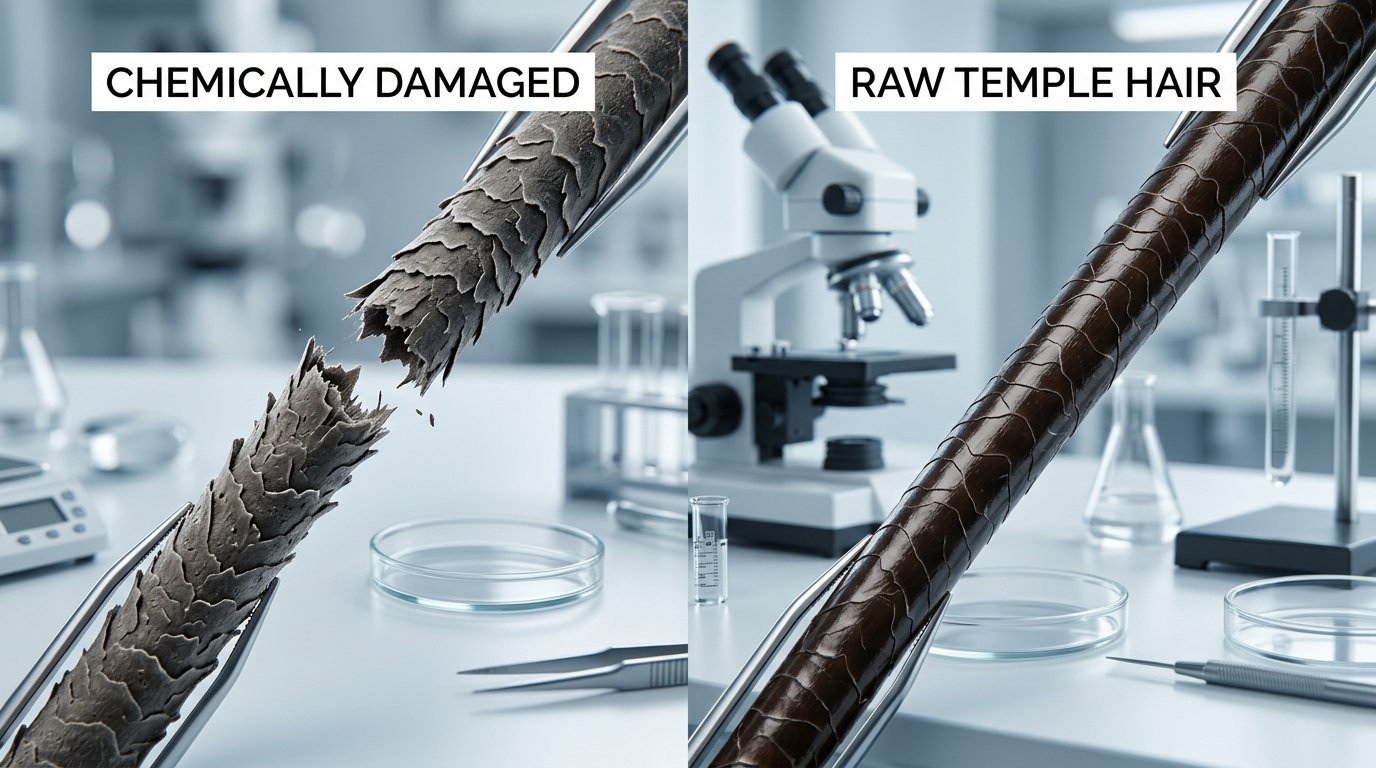
At Silky Fusion, our wigs and hair systems are made from 100% pure raw Indian temple hair with fully intact, healthy cuticles.
Because our hair hasn't been stripped with harsh acid baths or coated in fake silicone grease, it responds beautifully to proper chemical care. When you've cleaned mineral buildup off our hair, it bounces right back to life—soft, bouncy, and lustrous, just like the day it left our workshop.
Treat your luxury hair like fine cashmere, protect it from hard mineral water, and you'll love it for years to come.